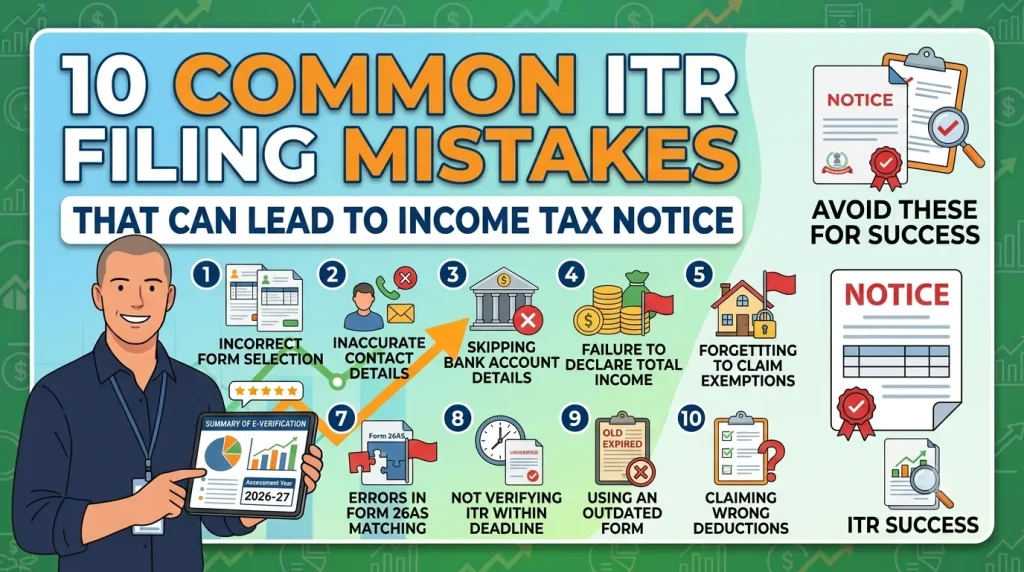
Every year, thousands of Indian taxpayers file their ITR believing they have done everything right — only to receive a notice from the Income Tax Department weeks later. Not because they tried to cheat the system, but because of small, avoidable errors that the department’s automated AI system picks up immediately.
The Income Tax Department increasingly uses artificial intelligence and advanced data analytics to match every deduction and income entry with source information. A Rs. 200 dividend you forgot to declare triggers the same automated mismatch flag as a large income discrepancy. A Rs. 50 dividend missing from your return triggers the same automated mismatch as a larger gap.
The good news is that almost all of these mistakes are preventable. Here are the 10 most common ones — check each one before you hit Submit this year.
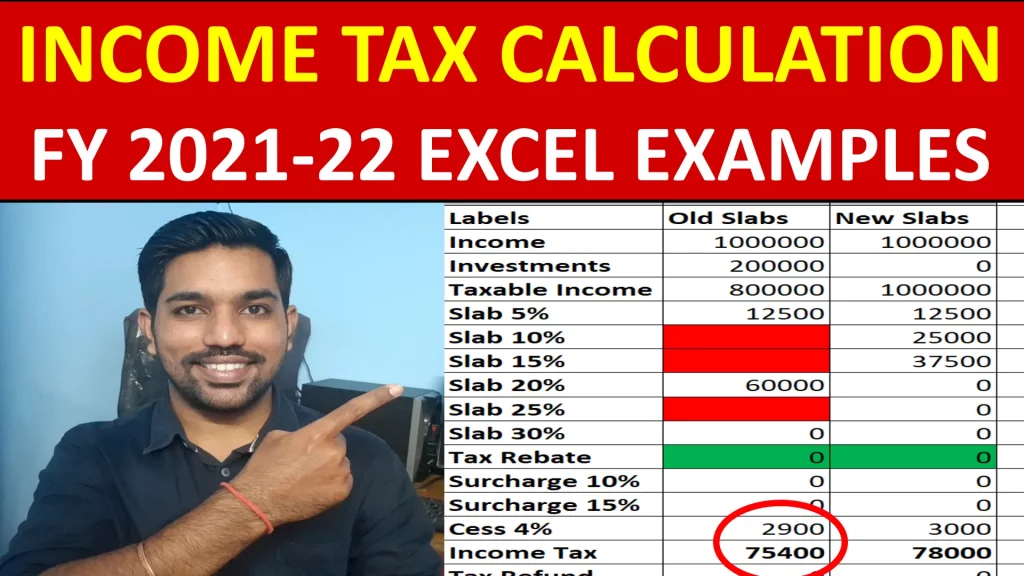
Download Income Tax Calculator in Excel using below button:
- Mistake 1 — Choosing the Wrong ITR Form
- Mistake 2 — Selecting the Wrong Assessment Year
- Mistake 3 — Not Reconciling AIS, TIS and Form 26AS
- Mistake 4 — Not Declaring All Income Sources
- Mistake 5 — Claiming Wrong or Excess Deductions
- Mistake 6 — Wrong Bank Account Details for Refund
- Mistake 7 — Not E-Verifying After Filing
- Mistake 8 — Not Reporting Exempt Income
- Mistake 9 — Filing Two Form 16s Without Consolidating Income
- Mistake 10 — Missing the Filing Deadline
- What Happens if ITR is Filed Incorrectly?
- Can We Correct ITR After Filing?
- Why is ITR Refund Delayed in 2026?
- Is CA Responsible for Wrong ITR Filing?
- Frequently Asked Questions on ITR Filing Mistakes
- Conclusion
Mistake 1 — Choosing the Wrong ITR Form
Selecting the wrong form can result in defective return notices and delays in processing. This is the most common reason a return gets flagged under Section 139(9) as defective.
- Use ITR-1 — salary income, up to 2 house properties, LTCG under Rs. 1.25 Lakh, total income below Rs. 50 Lakh
- Use ITR-3 — business income, F&O trading, company directors
- Use ITR-4 — small business or freelance income under presumptive taxation scheme
The most common wrong choice is a salaried person using ITR-1 despite having redeemed mutual funds with gains above Rs. 1.25 Lakh — which requires ITR-2. If you changed jobs, were a company director even briefly during the year, or have crypto income, you almost certainly cannot use ITR-1.
ALSO READ: ITR 1 vs ITR 2 vs ITR 3 vs ITR 4 which Form to File
Mistake 2 — Selecting the Wrong Assessment Year
For FY 2025-26, the correct corresponding AY is 2026-27. Mentioning the wrong AY increases the chances of double taxation and attracts unnecessary penalties. One digit off and your return is filed for the wrong year entirely.
- Income earned April 2025 to March 2026 = FY 2025-26
- The ITR you file for this income = AY 2026-27
When the portal asks for Assessment Year, always verify it says 2026-27 before proceeding. This mistake is more common when people file in a hurry in the last few days before the deadline.
Mistake 3 — Not Reconciling AIS, TIS and Form 26AS
This is the single biggest trigger for income tax notices in India today. For AY 2026-27, the most common ITR filing mistake is failing to reconcile your AIS and Form 26AS before submitting.
The Income Tax Department already has a complete record of your financial transactions — salary, FD interest, dividends, mutual fund redemptions, property transactions — all linked to your PAN through AIS. When you file your ITR without checking AIS first, and your declared figures do not match what the system has on record, an automated notice is generated.
Before filing — download your Form 26AS, AIS, and TIS from incometax.gov.in and cross-check every income line item. I have explained how to download these in a separate article. Spend 20 minutes on this step and you eliminate the most common reason people receive notices.
ALSO READ: How to Download AIS and Form 26AS
Mistake 4 — Not Declaring All Income Sources
Common income reporting errors include not reporting or under-reporting interest income on savings accounts or fixed deposits, not reporting salary income from all employers, and missing other income sources.
Income people commonly forget to declare:
- Savings account interest — small but taxable and visible in AIS. Deductible up to Rs. 10,000 under 80TTA, but must be declared first
- FD interest — banks deduct only 10% TDS, but if your tax slab is 20% or 30%, the balance is still your liability
- Dividend income — fully taxable above Rs. 5,000 per year in old regime, and fully visible in AIS
- Salary from previous employer — if you changed jobs, both salary amounts must be added together
- Crypto or VDA income — omitting crypto and Virtual Digital Asset income is one of the top mistakes for AY 2026-27, as VDA transactions now have dedicated reporting in AIS through exchange data
- Freelance or part-time income — even informal cash payments are taxable income
ITR 2 Filing with STCG Examples Video

Watch more Videos on YouTube Channel
Mistake 5 — Claiming Wrong or Excess Deductions
Taxpayers have been receiving income tax notices lately, especially related to deductions and exemptions claimed. The Income Tax Department increasingly uses AI to match every deduction with source information.
Two types of errors happen here:
Claiming deductions not actually made:
- Section 80C investments of Rs. 1,50,000 claimed but only Rs. 80,000 actually invested
- HRA claimed for months when rent was not actually paid
Claiming deductions under the wrong regime:
- 80C, 80D, HRA deductions are not available under the new tax regime
- If you filed under the new tax regime but still claimed these deductions, the return will be processed incorrectly and you may receive a demand notice
Always match every deduction you claim with the actual investment receipt or proof. The department can and does ask for documentation during scrutiny.
Mistake 6 — Wrong Bank Account Details for Refund
Taxpayers expecting refunds should carefully verify bank account details, including account number and IFSC code. Incorrect details can delay refund processing.
Your refund will fail to credit if:
- Account number has a typo
- IFSC code is wrong or outdated (banks change IFSC codes after mergers)
- Bank account is not pre-validated on the income tax portal
- Bank account is not linked to your PAN
Before filing, go to My Profile → Bank Account on the income tax portal and confirm your refund account is marked as Validated and EVC Enabled. This takes two minutes and saves weeks of waiting.
ALSO READ: Tax Rebate Section 87A with New Tax Regime
Mistake 7 — Not E-Verifying After Filing
Filing without e-verifying is like submitting an exam paper without writing your name on it — it simply does not count.
The time limit for ITR verification online is 30 days from submitting the ITR as per the new rule. Previously this time limit was 120 days. This new rule is applicable for returns filed on or after 1st August 2022.
If you miss the 30-day window, your ITR is treated as not filed — with all the consequences of non-filing including late fees, interest, and loss of carry-forward of losses. E-verify using Aadhaar OTP immediately after filing — it takes under 2 minutes.
ALSO READ: 5 Methods to E verify your ITR (Income Tax Return)
Mistake 8 — Not Reporting Exempt Income
Many taxpayers assume exempt income does not need to be declared. That is incorrect. Exempt income must also be disclosed in the ITR.
Exempt income that must still be declared:
- PPF interest — exempt under Section 10(11) but must be reported in the return
- Long-term capital gains from equity up to Rs. 1.25 Lakh — exempt under Section 112A but must be declared in Schedule 112A
- Gratuity received — exempt up to a limit but must be reported
- Maturity proceeds from life insurance policies — exempt under 10(10D) but reportable
Not declaring exempt income creates a mismatch with AIS, which records these transactions regardless of their tax status. The department sees the transaction, does not see the declaration, and generates a notice asking for an explanation.
Mistake 9 — Filing Two Form 16s Without Consolidating Income
This mistake is specific to people who changed jobs during FY 2025-26 and is more common than you would think.
A major reason for filing wrong income tax returns is not consolidating salary income from multiple employers. Many taxpayers add gross salary but accidentally claim the standard deduction of Rs. 75,000 twice — once in each employer’s calculation. The portal cross-checks employer-wise data in AIS and flags this.
If you changed jobs:
- Add the gross salary figures from both Form 16s to get your total salary income
- Claim standard deduction only once — Rs. 75,000 under new regime, Rs. 50,000 under old regime
- Verify total TDS from both employers matches the combined TDS in Form 26AS
- If your second employer did not account for income from the first employer while calculating TDS, you may have a tax shortfall to pay
Mistake 10 — Missing the Filing Deadline
If you miss the deadline, you will have to pay a late fee under Section 234F — Rs. 1,000 for income of Rs. 5 Lakh or less, Rs. 5,000 for income above that — and you will not get to avail of any of the benefits of capital losses and business losses for the year.
Deadlines for AY 2026-27:
- July 31, 2026 — salaried individuals filing ITR-1 and ITR-2
- August 31, 2026 — ITR-3 and ITR-4 filers not requiring audit
Filing in a last-minute rush is exactly when mistakes happen. Filing at the last minute under time pressure is how all 9 mistakes above get made. Give yourself at least a week before the deadline, not two hours.
ALSO READ: How to File ITR 1 Online for Salaried Employees
What Happens if ITR is Filed Incorrectly?
Depending on the nature of the mistake:
- Defective return notice under Section 139(9) — wrong form used, mandatory fields left blank. You get 15 days to correct it
- Mismatch intimation under Section 143(1) — income declared does not match AIS or Form 26AS. Department adjusts tax and sends demand or refund accordingly
- Demand notice — if you underpaid tax due to an error, you receive a demand for additional tax plus interest under Section 234A at 1% per month
- Scrutiny notice under Section 143(2) — for high-value mismatches or specific red flags, your return is selected for detailed scrutiny
- A penalty of 50% of the underreported income applies in cases where income is underreported. For cases involving misreporting, the penalty can go up to 200% of the tax on misreported income.
Most honest mistakes that are corrected promptly through a revised return do not escalate to penalties. The key is acting quickly.
Can We Correct ITR After Filing?
Yes — and this is the most important thing to know if you have already filed with an error.
As long as you file your revised return on or before the deadline — December 31, 2026 for AY 2026-27 — there is no penalty or late fee for revising your return. The department treats the revised return as your final, active filing.
There is no statutory limit on the number of times you can file a revised return, provided each revision is done within the deadline.
How to file a revised return:
- Log in to incometax.gov.in
- Go to e-File → Income Tax Returns → File Income Tax Return
- Select AY 2026-27 and choose Revised Return under Section 139(5)
- Enter your original ITR acknowledgement number and date
- Make all corrections, verify, submit, and e-verify
If you miss even the December 31, 2026 deadline, you can still file an Updated Return (ITR-U) under Section 139(8A) — but this comes with additional tax of 25% to 50% of the incremental tax and interest payable.
Why is ITR Refund Delayed in 2026?
The income tax refund delay affecting 24 lakh taxpayers in 2026 stems from processing backlogs, data mismatches, NUDGE campaign compliance checks, and verification issues.
The most common reasons your refund may be on hold:
- Mismatch between ITR and Form 26AS or AIS — the most common reason. The system puts the refund on hold pending resolution
- Bank account not pre-validated — refund cannot be credited to an unvalidated account
- Return not e-verified — no processing happens without e-verification
- Pending notice not responded to — if a notice is sitting in your portal inbox unread, your refund stays on hold
- If your refund shows On Hold for over 90 days, contact the Centralized Processing Centre at helpdesk@cpc.incometax.gov.in or your jurisdictional Assessing Officer and request specific reasons in writing.
Is CA Responsible for Wrong ITR Filing?
Legally, the taxpayer is ultimately responsible for the accuracy of the ITR filed under their PAN — not the CA. Income tax notices come to you, not to your CA. Any demand, penalty, or scrutiny assessment is your liability as the taxpayer.
That said, if a CA made an error due to negligence or incorrect professional advice, you may have grounds to hold them professionally accountable separately. But that process does not protect you from the Income Tax Department’s notices — you still need to respond and correct the return on your own timeline.
What this means in practice: Always review your ITR before your CA submits it. Confirm the form is correct, all income is declared, deductions match your actual proofs, and the tax computation looks right. Five minutes of your review can prevent months of back-and-forth with the department.
Frequently Asked Questions on ITR Filing Mistakes
What happens if ITR is filed incorrectly? You may receive a defective return notice, a mismatch intimation under Section 143(1), or a demand for additional tax with interest. For underreported income, a penalty of 50% of the underreported tax applies. Most honest mistakes can be corrected by filing a revised return before December 31, 2026.
How much fine for a wrong tax return? Penalty for underreporting income is 50% of the tax on underreported income. For cases involving deliberate misreporting, the penalty can go up to 200% of the tax on misreported income. Late filing also attracts a fee of Rs. 1,000 or Rs. 5,000 under Section 234F, and interest under Section 234A on unpaid tax at 1% per month.
Can we correct ITR after filing? Yes. File a revised return under Section 139(5) before December 31, 2026. There is no penalty for filing a revised return within the deadline. If you miss December 31, you can file an updated return (ITR-U) under Section 139(8A) with an additional tax of 25% to 50%.
Why is the ITR refund delayed in 2026? The primary reasons include data mismatches between your ITR and AIS or Form 26AS, unverified returns, bank account not pre-validated, and processing backlogs. Check your e-filing portal for any pending notices under Section 143(1) — a notice sitting unread is the most common reason refunds go on hold.
Is CA responsible for wrong ITR filing? Legally, the taxpayer is the person accountable to the Income Tax Department for their return — not the CA. Notices and demands always come to you. Review your return before it is submitted and confirm every figure, regardless of who is filing it on your behalf.
Conclusion
Filing your ITR correctly is just as important as filing it on time. Use the income tax calculator on this page to know your exact tax liability before you open the portal, download your AIS and Form 26AS first, and give yourself enough time before the July 31 deadline to review everything carefully. A clean, accurate return filed on time — with immediate e-verification — is all it takes to avoid every single mistake on this list.
Save Home Loan Interest Amount!
Use Home Loan Excel Calculator that will help you to Save Interest Amount on Home Loan EMI.
Click below button to download Home Loan EMI and Prepayment Calculator in Excel:
Watch how Home Loan Calculator in Excel Works
Income Tax Calculator App – FinCalC
For Income Tax Calculation on your mobile device, you can Download my Android App “FinCalC” which I have developed for you to make your income tax calculation easy.
What you can do with this mobile App?
- Calculate Income Tax for FY 2025-26 and previous FY 2024-25
- Enter estimated Investments to check income tax with Old and New Tax Regime
- Save income tax details and track regularly
- Know how much to invest more to save income tax
- More calculators including PPF, SIP returns, Savings account interest and lot more
Use Popular Calculators:
- Income Tax Calculator
- Home Loan EMI Calculator
- SIP Calculator
- PPF Calculator
- HRA Calculator
- Step up SIP Calculator
- Savings Account Interest Calculator
- Lump sum Calculator
- FD Calculator
- RD Calculator
- Car Loan EMI Calculator
- Bike Loan EMI Calculator
- Sukanya Samriddhi Calculator
- Provident Fund Calculator
- Senior Citizen Savings Calculator
- NSC Calculator
- Monthly Income Scheme Calculator
- Mahila Samman Savings Calculator
- Systematic Withdrawal Calculator
- CAGR Calculator
I’d love to hear from you if you have any queries about Personal Finance and Money Management.
JOIN Telegram Group and stay updated with latest Personal Finance News and Topics.
Download our Free Android App – FinCalC to Calculate Income Tax and Interest on various small Saving Schemes in India including PPF, NSC, SIP and lot more.
Follow the Blog and Subscribe to YouTube Channel to stay updated about Personal Finance and Money Management topics.
Disclaimer: Mutual Fund investments are subject to market risks, read all scheme related documents carefully. Registration granted by AMFI, membership of SIRO (if applicable), and certification from NISM in no way guarantee performance of the intermediary or provide any assurance of returns to investors.
Distributor Details: Name: Abhilash Gupta | AMFI Registered Mutual Fund Distributor | ARN: 367014