
SWP full form is Systematic Withdrawal Plan which helps you to earn monthly income based on your Investment Amount. SWP in Mutual Fund simply means, the accumulated amount that you have worked for since last many years, help you to earn returns from mutual funds, typically in the range of 10% to 18%, based on the mutual fund performance – And you withdraw systematically from this mutual fund, in such a way that you cover the monthly expenses and also the investment amount grows over time. This investment helps you to beat inflation due to market returns.
You can also download SWP Excel Calculator to calculate your monthly income based on mutual fund investments:
Let us understand SWP in Mutual Fund in more detail.
What is SWP in Mutual Fund?
- SWP in Mutual Fund simply refers to the monthly income you earn based on your investment in mutual funds
- SWP full form is Systematic Withdrawal plan that helps you to cover the monthly expenses that is very useful during your retirement phase
- It is important to understand that you need to start SWP only when you have accumulated enough corpus amount in the mutual funds
- For example, if you have Rs. 1 Crore as mutual fund investment, and if we consider 12% returns on yearly basis, than you get approximately Rs. 12 Lakh in a year, which comes down to Rs. 1 Lakh per month
- So Rs. 1 Lakh per month can be your monthly returns you can get from the mutual fund portfolio. But if you withdraw entire Rs. 1 Lakh, which means your portfolio amount will remain as Rs. 1 Crore
- You need to withdraw the amount that is less than Rs, 1 Lakh per month, since you also have to consider Inflation, which increases the your expenses every year
- So SWP Calculator with Inflation can help you quickly know how much investment amount you should have in mutual funds to cover for your monthly expenses for next 30 to 40 years without working actively
- Ultimately, SWP in mutual fund helps you to cover your monthly expenses, without you working on active income. And it is better to withdraw the amount that is less than the actual returns from investment (4% withdrawal rule) in order to grow your money over time
ALSO READ: SWP for Monthly Income with Calculations
How SWP Works?
SWP working is very simple and the only thing you need to know is – SWP allows you to withdraw from mutual fund or any other Liquid investment to cover the expenses.
Let us understand SWP with an example:
- First, you need to accumulate good amount of corpus in Mutual funds either using Lumpsum investment or via SIP (Systematic Investment Plan)
- Now, how much you should accumulate? Depends on how much you want to withdraw from the mutual funds or what is your average monthly expenses
- Let’s say you want to get Rs. 1 Lakh per month from mutual funds via SWP – systematic withdrawal plan
- And you expect returns of 12% per year as we can historically see that Index mutual funds have given since last 20 to 25 years
- So based on this returns, and Rs. 1 Lakh monthly income, you need Rs. 12 Lakh yearly income based on 12 months projection
- So what is the total amount on which 12% of returns would give you Rs. 12 Lakh yearly amount? Based on these numbers, we realize that you need to accumulate at least Rs. 1 Crore in mutual funds to get this yearly or monthly income
- So this is how you can work with your numbers and monthly expenses to know how much corpus you need to have in mutual funds
- But there is a catch here. You cannot remove entire Rs. 12 Lakh per year since you have not considered Inflation and market volatility in this case
- Inflation – This increases the expenses or the price of the items that you buy. For example, if your current monthly expense is Rs. 50,000, it is not necessary that after 10 years the expenses will be same. We have seen that on yearly basis, inflation rate is 6%, which means the expenses increase by 6% on average for all the household items you buy
- Market Volatility – We have considered 12% expected returns based on past returns of the market. This is not guaranteed. In few years the returns can be 4 to 6% and in other years the returns might be 15 to 18% yearly. So we cannot get consistent 12% returns every year from market
- So these 2 factors should be considered due to which we have something called as 4% withdrawal rule in SWP, which we will discuss in next section
SWP for Monthly Income Video

Watch more Videos on YouTube Channel
SWP Withdrawal Rule of 4%
- Based on SWP Withdrawal Rule of 4%, you should only withdraw 4% of your total investment amount every year to cover the expenses and to beat inflation, while growing your investment amount
- So, this rule says that instead of withdrawing Rs. 12 Lakh every year, from Rs. 1 Crore portfolio amount, you should only withdraw 4% (Rs. 4 Lakh) to cover the yearly expenses
- Now since we have reduced the amount to Rs. 4 Lakh in a year, does this cover your expenses of Rs. 12 Lakh in a year? NO
- If your expenses are Rs. 12 Lakh in a year, this amount should be 4% of the total amount, so what would be the total amount?
- Based on the calculation, the total portfolio amount that you need now is Rs. 3 Crore, from which 4% withdrawal in a year would be 12 Lakh that should cover your yearly on monthly expenses
- This is called margin of safety. While going from Rs. 1 Crore to Rs. 3 Crore, you are covering the expenses, you’ll beat inflation as well since the investment amount will grow over time and your corpus amount will probably earn you returns over your lifetime
- Magic of 4% withdrawal rule helps you to achieve Financial Independence and also help you to retire early
Use below Retirement Excel Calculator to plan for Retirement
SWP Benefits
Below are some of the SWP Benefits:
Regular Income – Provides a steady stream of cash flow at chosen intervals (monthly, quarterly, etc.), making it ideal for retirees or those seeking passive income. You have the option of choosing the frequency of withdrawal such as monthly or quarterly
Flexibility – Investors can decide the withdrawal amount, frequency, and duration, based on their financial needs, mostly to help cover their expenses during retirement phase or as passive income stream
Capital Preservation – Unlike lump-sum withdrawals, SWPs allow partial withdrawals while keeping the remaining investment growing in the market. This remaining investment amount in mutual fund is important as it grows the portfolio amount and your net worth
Tax Efficiency – Tax is calculated only on the gains portion of each withdrawal, not the principal, making it more efficient compared to fixed deposits or pensions. Read more about Short term and Long term Capital Gains. You can save tax on capital gains using tax harvesting, which means for LTCG, you don’t have to pay tax on profit up to Rs. 1.25 Lakh in a financial year
Market-Linked Growth – The balance left in the mutual fund continues to earn returns and grow your wealth, potentially offsetting monthly or quarterly withdrawals over time.
Retirement Planning Tool – Acts as a substitute for pension, ensuring consistent income post-retirement when regular salary stops.
Emergency Support – Can serve as a backup income source during emergencies such as job loss or delayed salaries. This is when you are already working in a job and have already accumulated good amount of corpus in mutual fund portfolio
SIP vs SWP Differences
Below are the differences between SIP and SWP:
| Features | SIP (Systematic Investment Plan) | SWP (Systematic Withdrawal Plan) |
| Purpose | Regular investing to accumulate wealth | Regular withdrawals to generate income |
| Cash Flow Direction | Money flows into mutual funds | Money flows out of mutual funds |
| Best Use Case | Wealth creation for long-term goals (education, house purchase, retirement corpus) | Steady income during retirement or when you need periodic cash flow |
| Investor Profile | Suitable for young earners, salaried individuals, or anyone building assets | Suitable for retirees, semi-retirees, or those needing supplemental income |
| Risk & Returns | Market-linked growth; benefits from rupee cost averaging | Market-linked withdrawals; remaining corpus continues to grow |
| Tax Treatment | Tax on gains when units are redeemed (usually long-term capital gains if held >1 year) | Tax only on the gains portion of each withdrawal, not the principal |
| Flexibility | Amount and frequency of investment can be chosen | Same like SIP, Frequency and Withdrawal amount can be chosen based on requirements |
| Timing | Ideal during earning years | Ideal during retirement or income-need years |
Which one to use when:
- Use SIP when:
- You are in your earning phase and want to build a corpus for future goals
- You prefer disciplined investing with small, regular contributions
- You want to benefit from rupee cost averaging and long-term compounding
- Use SWP when:
- You are in your retirement or post-accumulation phase
- You need a steady income stream without liquidating your entire investment
- You want tax-efficient withdrawals while keeping your corpus invested
Frequently Asked Questions
Is SWP a Good Investment?
Yes SWP or systematic withdrawal plan is one of the best strategy you can use to systematically withdraw from mutual funds. It allows you to cover the monthly expenses based on the returns you get from mutual fund portfolio amount.
What is the 4% rule for SWP?
Based on 4% rule for SWP, you should only withdraw 4% of your total mutual fund investment in a year to cover your yearly expenses. So, if your total investment is already Rs. 1 Crore in mutual fund, you should withdraw up to Rs. 4 lakh to cover your expenses and grow the investment amount at the same time. This helps you to grow your wealth over long period
Is SWP better than FD?
SWP and FD (Fixed Deposits) are 2 different ways to allocate funds. SWP can be used to get regular monthly income based on your mutual fund investment amount, where as FD is a debt instrument that can help you to keep emergency funds. Both have different purpose. Use SWP when you need monthly income and you already have a good amount of corpus as mutual fund portfolio. Use FD as an emergency fund that can be easily accessed when you need money for emergency or during loss of job where you get 6 months to 12 months expenses covered using FD amount.
Who is Better, SIP or SWP?
SIP (Systematic Investment Plan) is a way to accumulate amount in mutual funds for your financial goals such as retirement planning, marriage, child education, buying a new house or a car, etc. Where as SWP (Systematic Withdrawal Plan) helps you to withdraw from mutual fund portfolio to cover the monthly expenses during the retirement phase. Start SIP when you are young in order to build wealth, and start SWP when you are in retirement phase with no active income, so that the passive income from SWP helps in covering the expenses. So both SIP and SWP are better in their own ways to achieve your financial goals.
Save Home Loan Interest Amount!
Use Home Loan Excel Calculator that will help you to Save Interest Amount on Home Loan EMI.
Click below button to download Home Loan EMI and Prepayment Calculator in Excel:
Watch how Home Loan Calculator in Excel Works
Income Tax Calculator App – FinCalC
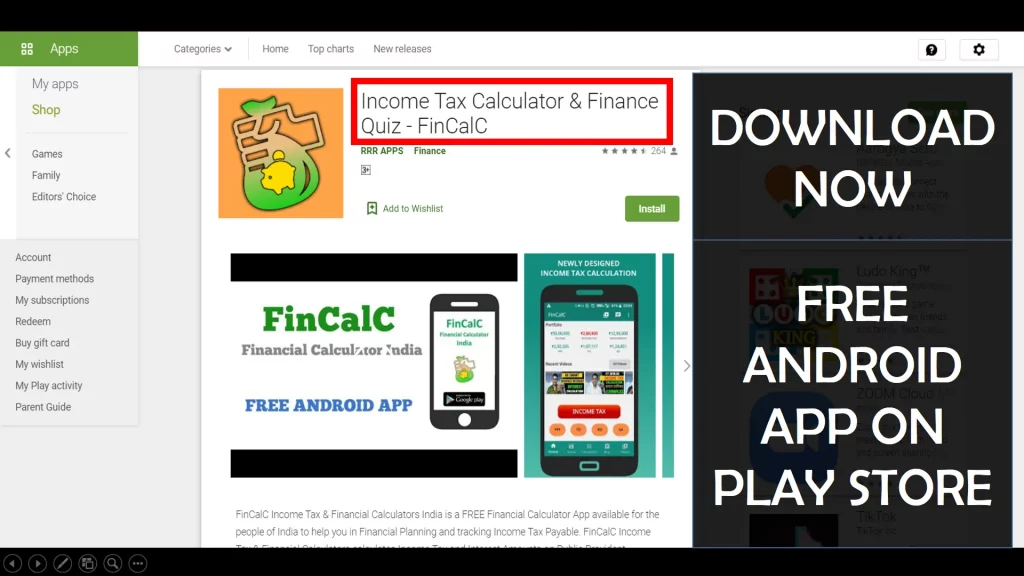
For Income Tax Calculation on your mobile device, you can Download my Android App “FinCalC” which I have developed for you to make your income tax calculation easy.
What you can do with this mobile App?
- Calculate Income Tax for FY 2025-26 and previous FY 2024-25
- Enter estimated Investments to check income tax with Old and New Tax Regime
- Save income tax details and track regularly
- Know how much to invest more to save income tax
- More calculators including PPF, SIP returns, Savings account interest and lot more
Use Popular Calculators:
- Income Tax Calculator
- Home Loan EMI Calculator
- SIP Calculator
- PPF Calculator
- HRA Calculator
- Step up SIP Calculator
- Savings Account Interest Calculator
- Lump sum Calculator
- FD Calculator
- RD Calculator
- Car Loan EMI Calculator
- Bike Loan EMI Calculator
- Sukanya Samriddhi Calculator
- Provident Fund Calculator
- Senior Citizen Savings Calculator
- NSC Calculator
- Monthly Income Scheme Calculator
- Mahila Samman Savings Calculator
- Systematic Withdrawal Calculator
- CAGR Calculator
I’d love to hear from you if you have any queries about Personal Finance and Money Management.
JOIN Telegram Group and stay updated with latest Personal Finance News and Topics.
Download our Free Android App – FinCalC to Calculate Income Tax and Interest on various small Saving Schemes in India including PPF, NSC, SIP and lot more.
Follow the Blog and Subscribe to YouTube Channel to stay updated about Personal Finance and Money Management topics.