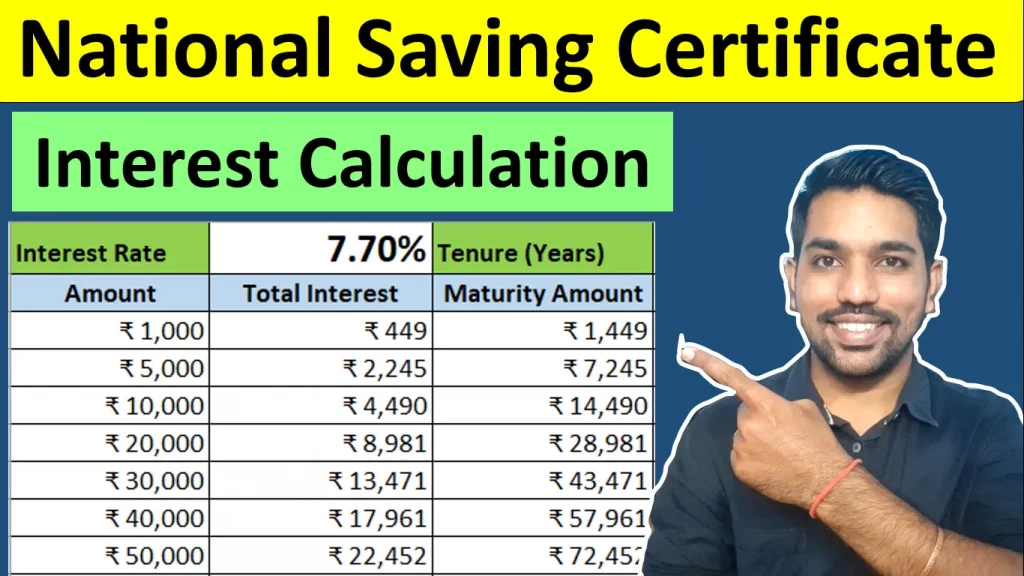
Post Office National Saving Certificate (NSC) interest rate is 7.7% for the July to September 2026 quarter. This rate hasn’t moved since April 2025 — the government has kept it unchanged for seven straight quarters now, which tells you it’s a fairly stable, low-drama option if you’re looking for guaranteed returns.
Here’s the part most people don’t realize: even though the government reviews and can revise this rate every quarter, whatever rate is active on the day you buy your NSC certificate stays locked in for the entire 5-year tenure. So if you invest today at 7.7%, you’ll keep earning 7.7% for all 5 years, even if the published rate changes next quarter.
- National Saving Certificate Calculator Video
- What is National Saving Certificate
- National Saving Certificate (NSC) Benefits
- Income Tax Benefits in National Saving Certificate
- What is the tenure of NSC (National Saving Certificate)?
- Is NSC better than FD?
- NSC Interest Rate History (Last 8 Quarters)
- Is NSC Interest rate fixed for 5 years?
- What is compounding in NSC?
- Frequently Asked Questions
- Conclusion
Let us understand the benefits and Interest calculation in National Saving Certificate.
National Saving Certificate Calculator Video

Watch more Videos on YouTube Channel
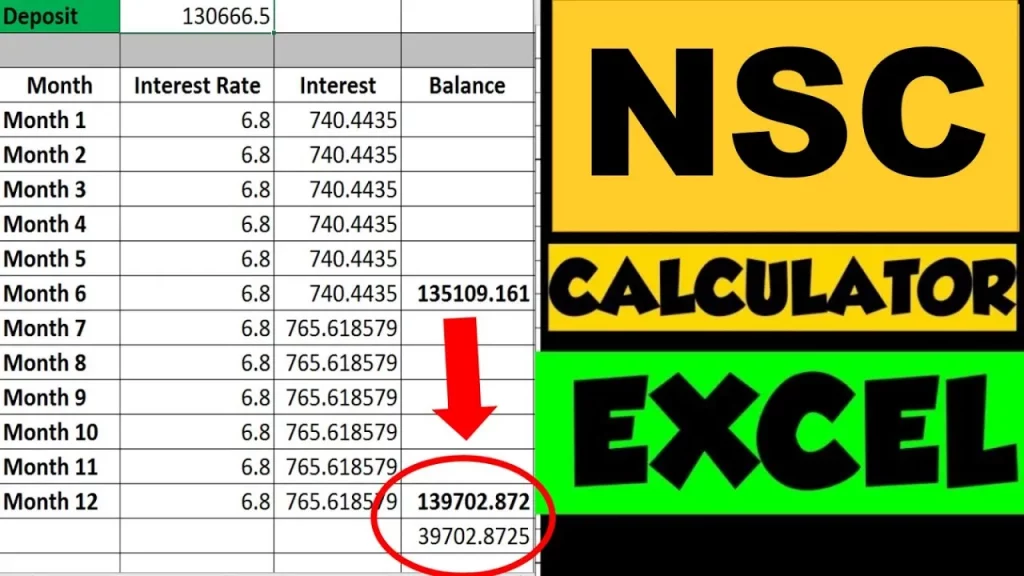
As seen above, you can easily calculate interest in National Savings Certificate using the NSC Calculator. Based on the deposit amount and interest rate, the NSC interest will be calculated every month and compounded on annual basis.
What is National Saving Certificate
- National Saving Certificate or NSC are the certificates issued by Post Office to save for your financial goals
- These are low risk investment scheme to get fixed interest amount
- NSC scheme is for the tenure of 5 years. This means the deposit amount will be locked for 5 years from the issue of this certificate
- Minimum amount you can invest is Rs. 1000 and there is no maximum limit to issue NSC certificate
- You can have multiple NSC certificates issued against your name
- It helps you to save income tax under Section 80C that has a maximum limit of Rs. 1.5 lakh with old tax regime
- Remember that new tax regime does not allow deduction with NSC certificates
- NSC certificates are physical certificates having the details amount investment amount, interest rate, tenure and maturity amount
- You can get the maturity amount encashed or transferred in bank account after maturity. Failing to do so will help you earn interest for next 2 years at post office savings account interest rate, post which you will not earn any interest
- The interest portion of maturity amount in NSC is taxable as per your tax slab rates

Let us now understand the benefits of NSC.
National Saving Certificate (NSC) Benefits
Below are some of the benefits of National Saving Certificate:
- Income Tax Saving: NSC or National Saving Certificate helps you to save income tax with old tax regime under Section 80C. This means you can claim maximum of Rs. 1.5 lakh in the financial year by investing in NSC
- High Interest Rate: The current interest rate in NSC is 7.7% for the July to September 2026 quarter, which is higher than most bank Fixed Deposits and Recurring Deposits, and on par with schemes like Kisan Vikas Patra.
- Achieve Financial Goals: NSC helps you to achieve your financial goal of 5 years. Since NSC accepts one time investments, you can deposit the amount and get interest amount after 5 years along with your principal amount.
Income Tax Benefits in National Saving Certificate
National Saving Certificate gives you an income tax deduction under Section 80C — only if you’re on the Old Tax Regime.
This means you can invest up to ₹1.5 lakh in a financial year to issue this certificate and claim that deduction. This benefit isn’t available if you’ve opted for the New Tax Regime, so factor that in before investing purely for the tax break.
Note: Under the new Income-tax Act, 2025, this deduction has been renumbered as Section 123 (replacing Section 80C of the earlier Income-tax Act, 1961). The rules and limits remain the same — only the section number has changed.
One thing worth knowing: the interest NSC earns each year is taxable, but it’s also treated as a fresh deposit for the first 4 years — meaning you can claim it again under Section 80C/123 (subject to your overall ₹1.5 lakh limit). Only the final year’s interest, paid out at maturity, is taxable without this reinvestment benefit.
Watch below video to understand the difference between PPF and NSC and which is a better saving scheme for you.
PPF vs NSC Interest Calculation – Which is Better? – Video

What is the tenure of NSC (National Saving Certificate)?
The tenure of NSC is 5 years. So the deposit you make in this certificate will be locked in for 5 years.
After 5 years, you can get the principal and interest amount from NSC certificates in your savings account.
Is NSC better than FD?
It depends on various factors to compare NSC with FD and let us try to do so with below points:
| Items | National Saving Certificate (NSC) | Fixed Deposits (FD) |
|---|---|---|
| Income Tax | Helps in Saving Income Tax under Section 80C | 5 year tax saver Fixed Deposit also helps in saving income tax with Section 80C |
| Liquidity | Difficult to break NSC certificates before 5 years but can be done based on some conditions | You can easily break or liquidate FD before 5 years |
| Account opening online | Currently it involves offline process of buying certificate via Post Office | You can easily open FD via net banking of your Savings account Bank |
| Compounding | Yearly compounding is done based on deposit | Quarterly compounding which gives you more interest amount |
| Interest rate | Current interest rate is 7.7% | Interest rate varies between 6.5% to7.5% based on the bank |
| Maturity amount (@7.7% interest rate) | You’ll get Rs. 72,452 on Rs. 50,000 deposit in NSC after 5 years | You’ll get Rs. 73,212 on Rs. 50,000 deposit in Fixed Deposit after 5 years |
As seen in above table, Fixed deposits are better compared to NSC if we see the liquidity, account opening steps and compounding factors. FD gives you more interest amount due to quarterly compounding, provided you get FD interest rate higher than NSC.
NSC is better in terms of interest rate, and can help you get yearly compounding
ALSO READ: FD Interest Calculation for 10 Years
NSC Interest Rate History (Last 8 Quarters)
Here’s how the NSC rate has moved recently — useful if you’re trying to time your investment or just curious how stable this scheme has been:
| Quarter | NSC Interest Rate |
|---|---|
| Jul–Sep 2026 | 7.7% |
| Apr–Jun 2026 | 7.7% |
| Jan–Mar 2026 | 7.7% |
| Oct–Dec 2025 | 7.7% |
| Jul–Sep 2025 | 7.7% |
| Apr–Jun 2025 | 7.7% |
| Jan–Mar 2025 | 7.7% |
| Oct–Dec 2024 | 7.7% |
As you can see, NSC has held steady at 7.7% for two full years now. If you’re deciding between locking in now or waiting for a possible rate hike, this track record suggests there’s no strong signal either way — the rate has simply been stable.
Is NSC Interest rate fixed for 5 years?
Yes NSC interest rate is fixed for the certificate you issue for the next 5 years. So, the interest rates of post office schemes are updated every quarter, but this does not impact the interest rate on existing NSC certificates that are issued already to you.
You’ll get the same interest rate in NSC throughout the tenure of 5 years.
What is compounding in NSC?
Compounding means you get interest amount on already earned interest. Based on the interest calculation every month for first financial year, the interest is summed up for all months in FY and added to your principal amount. This means in upcoming financial years, you’ll earn more interest amount on this already earned interest.
Frequently Asked Questions
Can I break or withdraw NSC before 5 years?
Generally no, except in specific cases like the death of the certificate holder, forfeiture by a pledgee (like a bank, if you’ve used it as loan collateral), or a court order. Outside these situations, your money stays locked for the full 5-year tenure.
Can NRIs invest in NSC?
No. NSC is only available to resident individuals. If you become an NRI after purchasing NSC, you can hold it until maturity, but you can’t purchase new certificates.
Is NSC interest paid out yearly, or only at maturity?
The interest compounds annually and gets added to your investment, but you don’t actually receive any cash until maturity. The full amount — principal plus all accumulated interest — is paid out together after 5 years.
Can I use NSC as collateral for a loan?
Yes. Many banks and NBFCs accept NSC certificates as collateral for secured loans, since they’re a government-backed instrument with a fixed maturity value.
Is NSC a better tax-saving option than ELSS or PPF?
It depends on your goals. NSC offers fixed, guaranteed returns with a shorter 5-year lock-in compared to PPF’s 15 years, but ELSS mutual funds have the potential for higher returns (though market-linked and non-guaranteed) with a shorter 3-year lock-in. If you want zero risk and predictable returns, NSC is a solid pick.
Conclusion
So to summarize, National Saving certificate current interest rate is 7.7%, which will be reviewed by government of India every quarter. Your deposit amount will be locked in for 5 years and you’ll earn monthly interest in NSC where as compounding will be done on yearly basis.
NSC provides you income tax benefits under Section 80C and maximum of Rs. 1.5 lakh can be claimed under old tax regime.
Some more Reading:
- Post Office Monthly Income Scheme Interest Rate and Calculation
- PPF Interest rate History
- Sukanya Samriddhi Yojana Scheme
Save Home Loan Interest Amount!
Use Home Loan Excel Calculator that will help you to Save Interest Amount on Home Loan EMI.
Click below button to download Home Loan EMI and Prepayment Calculator in Excel:
Watch how Home Loan Calculator in Excel Works
Income Tax Calculator App – FinCalC
For Income Tax Calculation on your mobile device, you can Download my Android App “FinCalC” which I have developed for you to make your income tax calculation easy.
What you can do with this mobile App?
- Calculate Income Tax for FY 2025-26 and previous FY 2024-25
- Enter estimated Investments to check income tax with Old and New Tax Regime
- Save income tax details and track regularly
- Know how much to invest more to save income tax
- More calculators including PPF, SIP returns, Savings account interest and lot more
Use Popular Calculators:
- Income Tax Calculator
- Home Loan EMI Calculator
- SIP Calculator
- PPF Calculator
- HRA Calculator
- Step up SIP Calculator
- Savings Account Interest Calculator
- Lump sum Calculator
- FD Calculator
- RD Calculator
- Car Loan EMI Calculator
- Bike Loan EMI Calculator
- Sukanya Samriddhi Calculator
- Provident Fund Calculator
- Senior Citizen Savings Calculator
- NSC Calculator
- Monthly Income Scheme Calculator
- Mahila Samman Savings Calculator
- Systematic Withdrawal Calculator
- CAGR Calculator
I’d love to hear from you if you have any queries about Personal Finance and Money Management.
JOIN Telegram Group and stay updated with latest Personal Finance News and Topics.
Download our Free Android App – FinCalC to Calculate Income Tax and Interest on various small Saving Schemes in India including PPF, NSC, SIP and lot more.
Follow the Blog and Subscribe to YouTube Channel to stay updated about Personal Finance and Money Management topics.
Disclaimer: Mutual Fund investments are subject to market risks, read all scheme related documents carefully. Registration granted by AMFI, membership of SIRO (if applicable), and certification from NISM in no way guarantee performance of the intermediary or provide any assurance of returns to investors.
Distributor Details: Name: Abhilash Gupta | AMFI Registered Mutual Fund Distributor | ARN: 367014