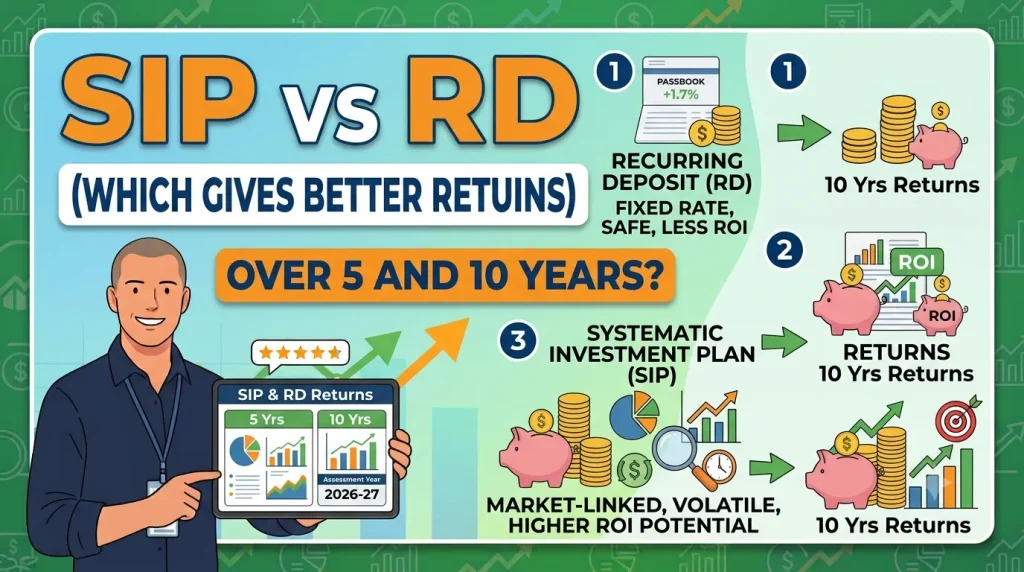
Every month, millions of salaried Indians deposit a fixed amount somewhere. Some open a Recurring Deposit at SBI or the Post Office because it feels safe and predictable. Others start a SIP in a mutual fund because they have heard it gives better returns. But very few actually sit down and compare the numbers side by side.
If you are trying to decide between SIP and RD right now — this article will settle the debate for you with actual calculations. Because the real answer to “which is better” is not an opinion. It is a number.
- What is RD and How Does It Work?
- What is SIP and How Does It Work?
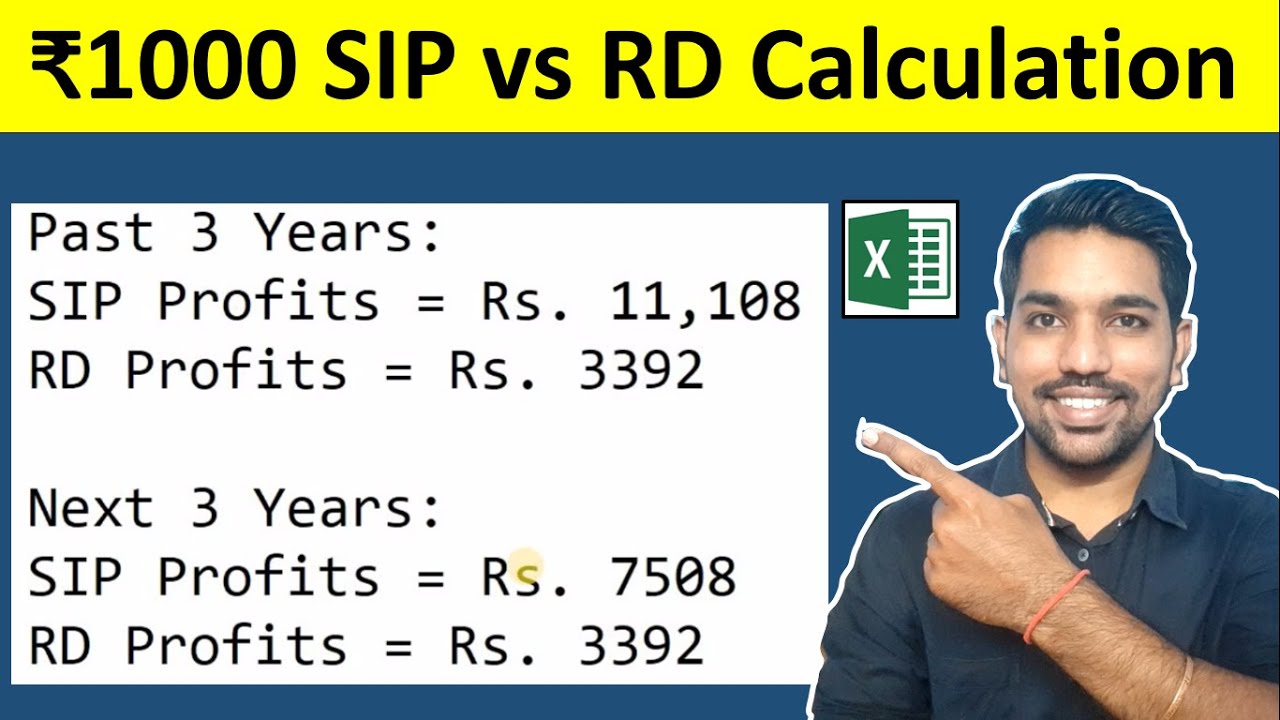
- Rs. 1000 SIP vs RD Returns Calculation VIDEO
- Current RD Interest Rates in 2026 (Major Banks)
- SIP vs RD – Returns Comparison Over 5 Years
- What is Rs. 5000 Per Month SIP for 10 Years?
- SIP vs RD – Detailed 10-Year Comparison Table (Rs. 10,000/month)
- SIP vs RD – Tax Treatment
- Which is Better — RD, FD, or SIP?
- Which Investment is Better Than RD?
- Is a Single SIP of Rs. 10,000 Better Than Two SIPs of Rs. 5,000 Each?
- When Should You Choose RD Over SIP?
- Quick Comparison Summary
- Frequently Asked Questions
What is RD and How Does It Work?
A Recurring Deposit (RD) is a savings instrument where you deposit a fixed amount every month for a fixed tenure and earn interest on the accumulated balance.
Unlike fixed deposits, recurring deposits do not require a lump-sum investment. Account holders make fixed monthly contributions for a specified tenure and, in return, earn interest similar to that offered on fixed deposits.
The Post Office RD interest rate has been kept unchanged at 6.7% for the July-September 2026 quarter. SBI provides RD interest rates in the range of 6.25–6.4% per annum to general citizens.
RD interest is taxable — it is added to your income and taxed as per your income tax slab. There is no 80C benefit on RD. The only RD that offers any tax benefit is a 5-year Tax Saver FD, which is a different product.
What is SIP and How Does It Work?
SIP — Systematic Investment Plan — is a method of investing a fixed amount every month in a mutual fund. Your money buys units of the fund based on that day’s NAV (Net Asset Value). Over time, through compounding and market growth, these units build into a corpus.
I have explained what is SIP, its features and benefits with returns calculation in detail on this blog. The key difference from RD is that SIP returns are market-linked — they are not guaranteed, but historically equity mutual funds have delivered 10%–15% CAGR over long periods.
Rs. 1000 SIP vs RD Returns Calculation VIDEO
Current RD Interest Rates in 2026 (Major Banks)
Most banks offer up to 7% interest rate on recurring deposits. SBI, HDFC Bank, Axis Bank, and other major banks are among those where you can expect up to 7%.
| Bank / Institution | RD Interest Rate (General) |
|---|---|
| Post Office RD | 6.7% p.a. (compounded quarterly) |
| SBI | 6.25%–6.4% p.a. |
| HDFC Bank | 6.5%–7.0% p.a. |
| Axis Bank | 6.5%–7.0% p.a. |
| Small Finance Banks | Up to 8%–8.5% p.a. |
For our comparison below, I will use 6.7% per annum (Post Office RD rate) as the RD return — which is among the highest available from a government-backed institution. This gives RD the best possible outcome in our comparison.
SIP vs RD – Returns Comparison Over 5 Years
Monthly investment: Rs. 5,000 | Tenure: 5 years (60 months)
RD at 6.7% per annum (compounded quarterly):
| Items | Amount |
|---|---|
| Total Invested | Rs. 3,00,000 |
| Estimated RD Maturity | Rs. 3,56,836 (approx.) |
| Interest Earned | Rs. 56,836 |
SIP in equity mutual fund at 12% per annum:
| Items | Amount |
|---|---|
| Total Invested | Rs. 3,00,000 |
| Estimated SIP Corpus | Rs. 4,12,432 |
| Returns Earned | Rs. 1,12,432 |
SIP in equity mutual fund at 15% per annum:
| Items | Amount |
|---|---|
| Total Invested | Rs. 3,00,000 |
| Estimated SIP Corpus | Rs. 4,48,408 |
| Returns Earned | Rs. 1,48,408 |
Over 5 years, SIP at 12% gives you Rs. 55,596 more than RD. At 15%, it gives Rs. 91,572 more — on the same Rs. 5,000 per month. However, there is an important note for 5-year SIPs — equity markets can be volatile over short periods. A 5-year SIP in equity can occasionally give lower returns than 12% in adverse market conditions. For a 5-year goal, a hybrid fund or balanced advantage fund is safer than a pure equity fund.
Use the SIP calculator on this blog to calculate your exact corpus for any amount and tenure before you invest.
What is Rs. 5000 Per Month SIP for 10 Years?
This is where the real power of SIP over RD becomes clear. Over 10 years, the compounding gap between 6.7% and 12% becomes massive.
Monthly SIP: Rs. 5,000 | Tenure: 10 years (120 months)
| Investment | Total Invested | Corpus | Returns |
|---|---|---|---|
| RD at 6.7% | Rs. 6,00,000 | Rs. 8,54,290 (approx.) | Rs. 2,54,290 |
| SIP at 10% | Rs. 6,00,000 | Rs. 10,32,760 | Rs. 4,32,760 |
| SIP at 12% | Rs. 6,00,000 | Rs. 11,61,695 | Rs. 5,61,695 |
| SIP at 15% | Rs. 6,00,000 | Rs. 13,93,286 | Rs. 7,93,286 |
RDs continue to appeal to risk-averse individuals who do not have a lump sum to invest and are looking for guaranteed returns. But over 10 years, even a conservative equity SIP at 10% gives Rs. 1,78,470 more than the Post Office RD. At 12%, the difference is Rs. 3,07,405 — on the exact same Rs. 5,000 per month investment.
The difference is not the amount — it is the return rate. And the return rate difference compounds every month for 10 years.
I have also explained SIP returns calculation examples in detail with a Rs. 2000 SIP on this blog — the same logic applies to any amount.
SIP vs RD – Detailed 10-Year Comparison Table (Rs. 10,000/month)
For those investing Rs. 10,000 per month — a common amount for mid-income salaried professionals:
| Investment | Total Invested | 10-Year Corpus | Returns Earned |
|---|---|---|---|
| RD at 6.7% | Rs. 12,00,000 | Rs. 17,08,581 (approx.) | Rs. 5,08,581 |
| SIP at 12% | Rs. 12,00,000 | Rs. 23,23,390 | Rs. 11,23,390 |
| SIP at 15% | Rs. 12,00,000 | Rs. 27,86,573 | Rs. 15,86,573 |
At Rs. 10,000 per month for 10 years, SIP at 12% gives you Rs. 6,14,809 more than RD. At 15%, the difference is over Rs. 10 Lakh — on the same monthly commitment, for the same 10 years.
SIP vs RD – Tax Treatment
This is where RD loses even more ground for people in the 20% and 30% tax brackets.
RD interest is fully taxable:
- Interest income from RD is added to your total income and taxed at your slab rate
- For someone in the 30% tax bracket, the effective post-tax return on a 6.7% RD is approximately 4.69%
- There is no tax benefit, no exemption, and no 80C deduction on regular RDs
SIP taxation:
- Long-term capital gains (LTCG) from equity mutual funds held for more than 1 year are taxed at 12.5% above Rs. 1.25 Lakh per year
- Short-term capital gains (STCG) for holdings under 1 year are taxed at 20%
- For a 10-year SIP redemption, most of your corpus qualifies as LTCG — and even at 12.5% tax, the post-tax returns are significantly better than RD
I have explained income tax on SIP maturity or redemption with detailed STCG and LTCG calculations on this blog. Also read equity mutual funds taxation with examples for a complete picture before you redeem.
Post-tax return comparison at 30% tax bracket:
| Investment | Pre-tax Return | Post-tax Return |
|---|---|---|
| RD at 6.7% | 6.7% | ~4.69% |
| SIP at 12% (equity, 10 years) | 12% | ~10.5% (after 12.5% LTCG) |
The post-tax difference is even larger than the pre-tax numbers suggest.
Which is Better — RD, FD, or SIP?
This is the most searched comparison, and the answer depends on your time horizon and risk tolerance.
RD vs FD: FD and RD offer similar interest rates from the same institution. FD requires a lump sum deposit, while RD allows monthly contributions. Post Office RD currently earns an interest of 6.70% quarterly compounded, similar to what you would get on a comparable FD. Both are taxable. For monthly savers with no lump sum, RD is more practical than FD.
RD vs SIP:
- For tenure under 2 years — RD wins. Equity SIP needs time to deliver its full benefit, and short-term market volatility can reduce returns
- For tenure 3 to 5 years — hybrid fund SIP vs RD is comparable in moderate markets, but SIP has higher potential
- For tenure 7+ years — SIP wins decisively. The data above makes this clear
FD vs SIP: For a lump sum investment, Rs. 10,000 FD vs mutual funds comparison is already covered on this blog with detailed calculations.
The simple verdict: For guaranteed safety on money you need in 1-3 years, use RD or FD. For building wealth over 5+ years, SIP in equity mutual funds gives significantly better returns — especially post-tax.
Which Investment is Better Than RD?
Several investments outperform RD over the medium to long term:
- Equity SIP — best for 7+ year goals. Historical CAGR of 10%–15%
- PPF — 7.1% tax-free, EEE category, better than RD post-tax for most investors. I have explained PPF calculations and features in detail here. The only downside is 15-year lock-in
- ELSS Mutual Funds — equity returns plus 80C deduction up to Rs. 1.5 Lakh with only 3-year lock-in. Read what is ELSS mutual funds here
- NPS — for retirement goals, NPS helps save income tax especially under new regime via 80CCD(2) employer contribution
- Step-Up SIP — a SIP where you increase your monthly amount by 10%–15% every year. I have explained SIP vs Step-Up SIP — which is better with full calculations here
The one area where RD genuinely outperforms is capital safety with guaranteed returns — something equity SIP cannot offer for short timeframes.
Is a Single SIP of Rs. 10,000 Better Than Two SIPs of Rs. 5,000 Each?
This is a great question — and the answer is: mathematically they are the same, strategically they can be different.
If you invest Rs. 10,000 per month in one fund vs Rs. 5,000 each in two funds at the same return rate — the final corpus is identical. The calculation does not change.
However, there are strategic reasons to split:
- Different fund categories — Rs. 5,000 in a flexi-cap fund + Rs. 5,000 in a mid-cap fund gives genuine diversification across market cap segments
- Different risk levels — Rs. 5,000 in an equity fund + Rs. 5,000 in a hybrid fund balances growth with stability
- Different goals — one SIP for retirement, another for a 7-year education goal — keeps your tracking clean
Where splitting does NOT help:
- Rs. 5,000 each in two large-cap funds from different AMCs — this is not diversification, it is portfolio overlap with extra complexity
- More than 5-6 SIPs total — too many funds become impossible to track meaningfully
I have explained the ideal portfolio of mutual funds in detail — the right number of funds and categories for a salaried investor’s portfolio.
When Should You Choose RD Over SIP?
Despite the clear return advantage of SIP, RD is the right choice in these specific situations:
- Emergency fund — money you may need within 6-12 months. Equity SIP can lose value in a market downturn exactly when you need it most. Read 5 steps to build a strong emergency fund here
- Short-term goal under 2 years — a vacation, a gadget, a down payment you need soon
- Very low risk tolerance — if even a 10% portfolio dip will cause you to redeem in panic, equity SIP will hurt you more than it helps
- Senior citizens — where capital preservation matters more than growth, and tax-efficient guaranteed instruments like SCSS or Senior Citizen FD may be more appropriate
For everything else — a 5-year SIP for a car, a 10-year SIP for a child’s education, a 20-year SIP for retirement — SIP in equity mutual funds is the superior choice by a significant margin.
Quick Comparison Summary
| Parameter | RD | SIP (Equity) |
|---|---|---|
| Returns | 6.5%–7% (guaranteed) | 10%–15% (not guaranteed) |
| Risk | Zero risk | Market risk |
| Tax | Fully taxable at slab rate | LTCG at 12.5% above Rs. 1.25L |
| Best for | Short term, guaranteed safety | Medium to long term wealth |
| Minimum amount | Rs. 100/month | Rs. 500/month |
| Liquidity | Partial (after 3 years in Post Office) | Anytime (subject to exit load) |
| Suitable tenure | 6 months to 5 years | 5 years and above |
Frequently Asked Questions
Which is better — RD, FD or SIP?
For short-term goals (under 3 years), RD and FD are better since they offer guaranteed returns with no market risk. For long-term goals (5+ years), SIP in equity mutual funds wins decisively — delivering 2x to 3x the corpus compared to RD on the same monthly investment, with better post-tax returns for most taxpayers.
What is Rs. 5,000 per month SIP for 10 years?
At 12% annual return, a Rs. 5,000 monthly SIP for 10 years grows to approximately Rs. 11.62 Lakh. Total invested is Rs. 6 Lakh — the remaining Rs. 5.62 Lakh is returns from compounding. Compared to RD at 6.7% for the same Rs. 5,000 over 10 years (which gives approximately Rs. 8.36 Lakh), SIP gives Rs. 3.26 Lakh more.
Which investment is better than RD?
PPF (7.1% tax-free, EEE category), ELSS mutual funds (equity returns + 80C benefit), equity SIP (10%–15% historical CAGR), and NPS (tax savings + market returns) all outperform RD over a 5+ year horizon. For shorter tenures, RD remains competitive due to guaranteed returns and capital safety.
Is a single SIP of Rs. 10,000 better than 2 SIPs of Rs. 5,000 each?
Mathematically identical in terms of total corpus if the return rate is the same. Strategically, two SIPs in genuinely different categories (say, one large-cap and one mid-cap) makes sense for diversification. But two SIPs in the same category or similar funds adds no benefit — it just increases complexity.
The RD vs SIP debate is not really a debate once you look at the numbers. RD is safe and predictable — and that matters for short-term money. But for wealth creation over 5, 10 or 20 years, the compounding difference between 6.7% and 12% becomes lakhs of rupees on the same monthly investment.
Save Home Loan Interest Amount!
Use Home Loan Excel Calculator that will help you to Save Interest Amount on Home Loan EMI.
Click below button to download Home Loan EMI and Prepayment Calculator in Excel:
Watch how Home Loan Calculator in Excel Works
Income Tax Calculator App – FinCalC
For Income Tax Calculation on your mobile device, you can Download my Android App “FinCalC” which I have developed for you to make your income tax calculation easy.
What you can do with this mobile App?
- Calculate Income Tax for FY 2025-26 and previous FY 2024-25
- Enter estimated Investments to check income tax with Old and New Tax Regime
- Save income tax details and track regularly
- Know how much to invest more to save income tax
- More calculators including PPF, SIP returns, Savings account interest and lot more

Use Popular Calculators:
- Income Tax Calculator
- Home Loan EMI Calculator
- SIP Calculator
- PPF Calculator
- HRA Calculator
- Step up SIP Calculator
- Savings Account Interest Calculator
- Lump sum Calculator
- FD Calculator
- RD Calculator
- Car Loan EMI Calculator
- Bike Loan EMI Calculator
- Sukanya Samriddhi Calculator
- Provident Fund Calculator
- Senior Citizen Savings Calculator
- NSC Calculator
- Monthly Income Scheme Calculator
- Mahila Samman Savings Calculator
- Systematic Withdrawal Calculator
- CAGR Calculator
I’d love to hear from you if you have any queries about Personal Finance and Money Management.
JOIN Telegram Group and stay updated with latest Personal Finance News and Topics.
Download our Free Android App – FinCalC to Calculate Income Tax and Interest on various small Saving Schemes in India including PPF, NSC, SIP and lot more.
Follow the Blog and Subscribe to YouTube Channel to stay updated about Personal Finance and Money Management topics.
Disclaimer: Mutual Fund investments are subject to market risks, read all scheme related documents carefully. Registration granted by AMFI, membership of SIRO (if applicable), and certification from NISM in no way guarantee performance of the intermediary or provide any assurance of returns to investors.
Distributor Details: Name: Abhilash Gupta | AMFI Registered Mutual Fund Distributor | ARN: 367014