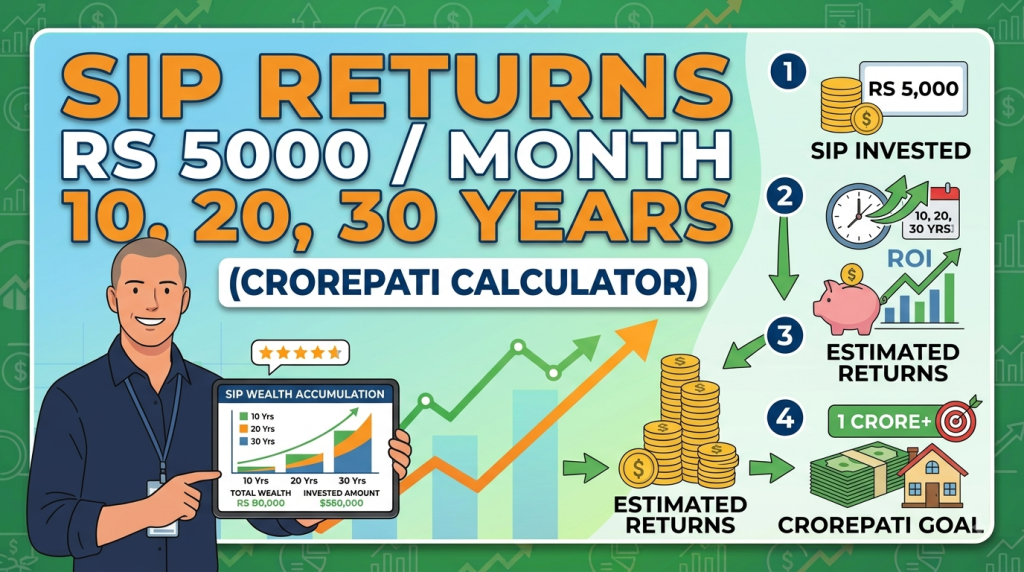
Rs 5,000. That is roughly what most people spend on one dinner out, or one streaming subscription plus a few impulse purchases. But if you invest that same Rs 5,000 every month in a mutual fund SIP starting today — what does it actually become in 10, 20, or 30 years?
Most people have a vague sense that “SIP is good for wealth creation.” But when I actually show them the numbers — specifically what Rs 5,000 per month becomes over 20 or 30 years — the reaction is almost always the same: “I wish I had started earlier.”
Let me show you exactly what happens to Rs 5,000 per month at different time horizons and return rates — with real calculations, not approximations.
- WATCH – Rs. 5000 SIP Returns Calculation for 10, 20, 30 Years
- SIP Calculator
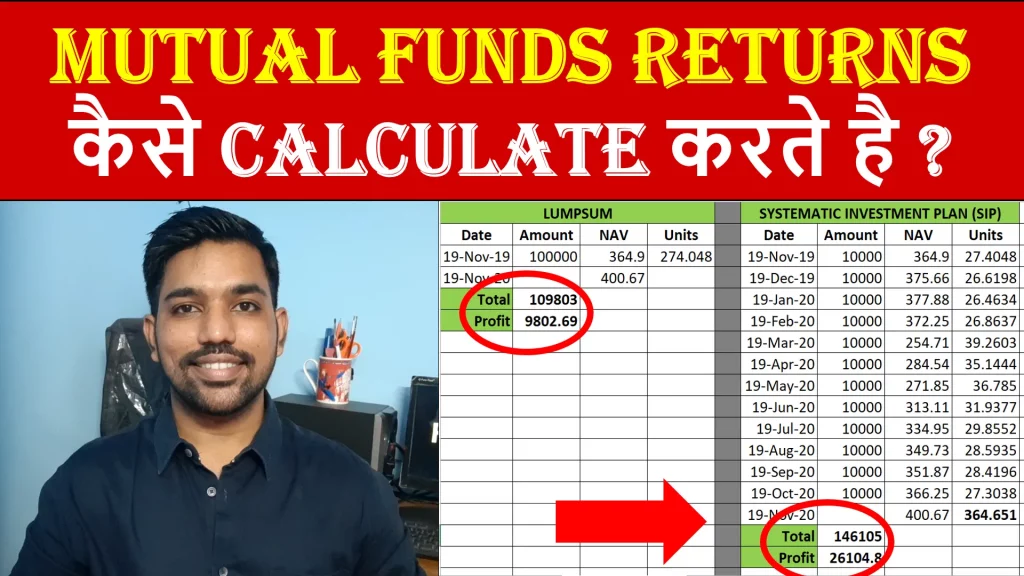
- How SIP Returns Are Calculated
- SIP Returns on Rs 5000 Per Month – Complete Table
- What if I Do SIP of Rs 5000 Per Month for 20 Years?
- How to Make 1 Crore in 20 Years by SIP
- How Much Can Rs 5000 Grow in 20 Years?
- How to Get 50 Lakhs in 10 Years with SIP
- How Can I Earn 1 Crore in 5 Years?
- What the Rs 5000 SIP Numbers Actually Mean for You
- Key Rules for a Successful Rs 5000 SIP
- Frequently Asked Questions on Rs 5000 SIP Returns
Watch below video to understand Rs. 5000 SIP Returns calculations for 5 years to 30 years with Calculator:
WATCH – Rs. 5000 SIP Returns Calculation for 10, 20, 30 Years
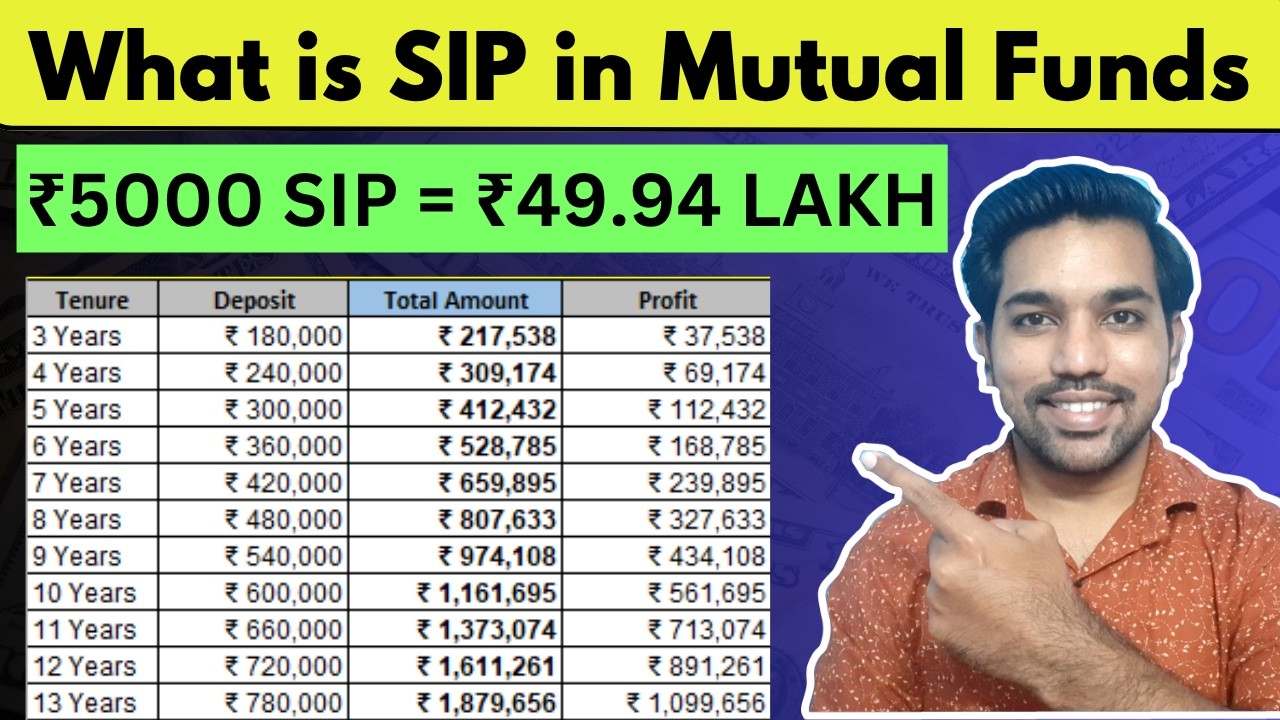
Watch more Videos on YouTube Channel
You can download SIP Calculator in Excel from here:
SIP Calculator
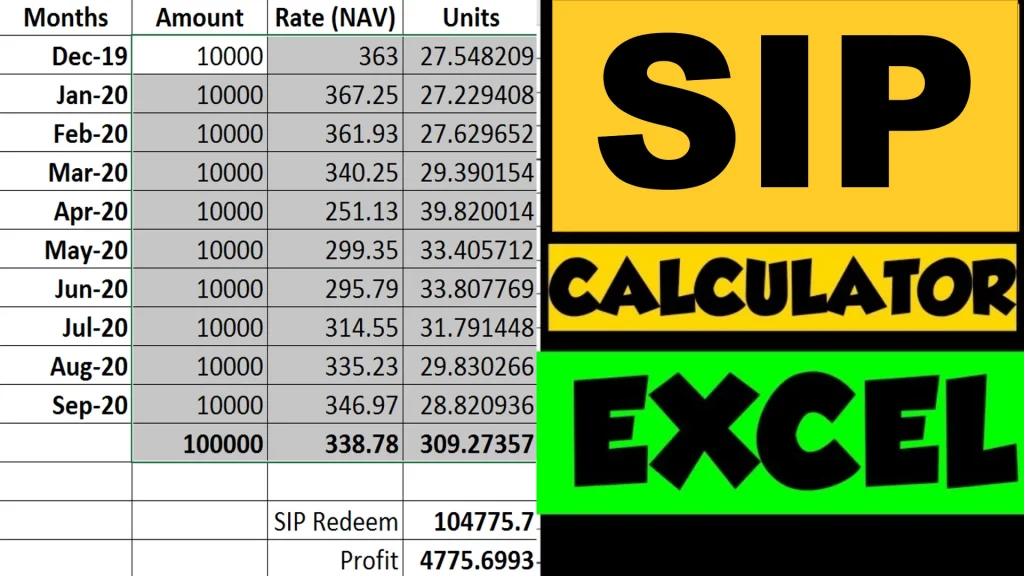
How SIP Returns Are Calculated
Before the numbers, let me explain the formula briefly so you understand what drives these results.
A common mistake is to simply divide the annual return by 12 to get the monthly rate. For example, taking 12% annual return as 12 ÷ 12 = 1% per month is not correct because returns are compounded. The right way is to convert the annual return into a monthly return using the compounding formula — for an annual return of 12%, the effective monthly return comes to about 0.95%, not 1%.
The SIP maturity formula is:
M = P × {[(1 + r)^n – 1] / r} × (1 + r)
Where:
- M = Maturity amount
- P = Monthly SIP amount (Rs 5,000)
- r = Monthly rate of return (annual rate ÷ 12, compounded)
- n = Number of months
I have used this exact formula for all calculations below. The SIP calculator on this page uses the same formula — use it to verify or calculate for your own numbers.
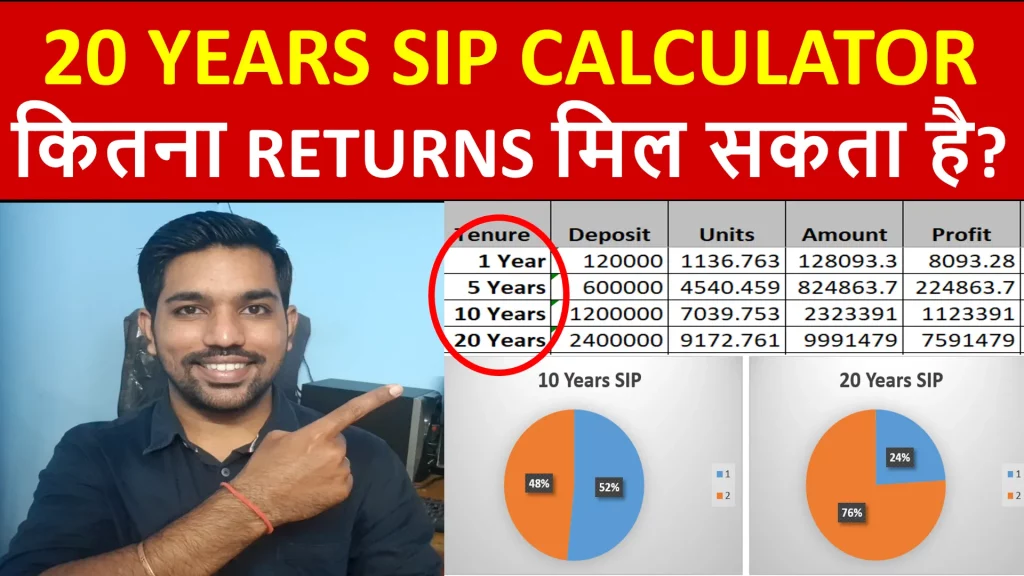
SIP Returns on Rs 5000 Per Month – Complete Table
Here is what Rs 5,000 per month becomes across three time horizons and three realistic return assumptions:
| Tenure | Total Invested | At 10% p.a. | At 12% p.a. | At 15% p.a. |
|---|---|---|---|---|
| 10 Years | Rs 6,00,000 | Rs 10.33 Lakh | Rs 11.62 Lakh | Rs 13.93 Lakh |
| 20 Years | Rs 12,00,000 | Rs 38.28 Lakh | Rs 49.96 Lakh | Rs 75.83 Lakh |
| 30 Years | Rs 18,00,000 | Rs 1.14 Crore | Rs 1.76 Crore | Rs 3.49 Crore |
Read that table carefully. You invested just Rs 18 Lakh over 30 years — and at 12% returns, it became Rs 1.76 Crore. At 15%, it became Rs 3.49 Crore.
The power of compounding works best over 15–20+ years. The same Rs 5,000 per month for 30 years at 12% gives Rs 1.76 Crore, but the same SIP for only 20 years gives Rs 49.9 Lakh — nearly 70% less corpus just because of 10 fewer years.
This is the single most important lesson in all of personal finance — time matters more than the amount.
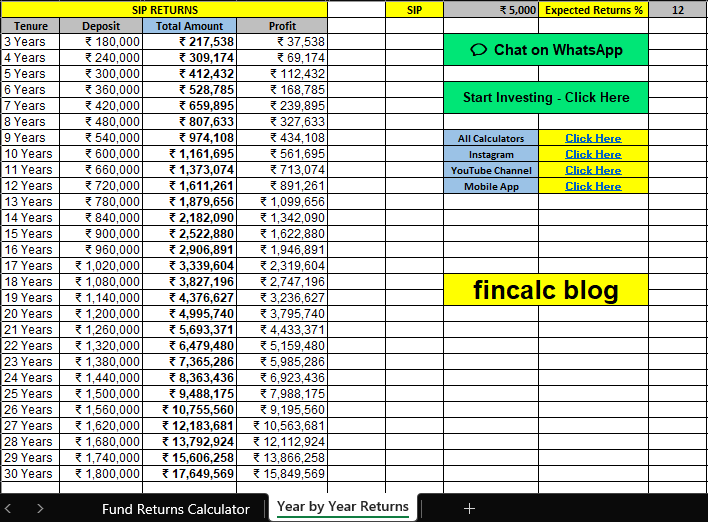
Below is the table of Rs. 5000 SIP per month at assumed rate of 12% for 3 to 30 Years:
ALSO READ: What is SIP in Mutual Funds – EXPLAINED
What if I Do SIP of Rs 5000 Per Month for 20 Years?
Let me go deeper on the 20-year scenario since this is the most searched question.
At 12% per annum (a conservative assumption for a well-chosen equity mutual fund):
| Amount | |
|---|---|
| Monthly SIP | Rs 5,000 |
| Total Invested in 20 Years | Rs 12,00,000 |
| Estimated Corpus at 12% | Rs 49.96 Lakh |
| Wealth Gain (Returns) | Rs 37.96 Lakh |
| Return on Investment | 3.16x your invested amount |
You invested Rs 12 Lakh over 20 years. Your money did the rest — earning Rs 37.96 Lakh in returns on top of your investment. That is 3x wealth multiplication on a Rs 5,000 monthly commitment.
At 15% (which better equity funds have historically achieved over long periods):
- Corpus = Rs 75.83 Lakh
- That is nearly 6x your total invested amount
The difference between 12% and 15% sounds small — just 3 percentage points. But over 20 years, it is the difference between Rs 49.96 Lakh and Rs 75.83 Lakh — a gap of nearly Rs 26 Lakh on the same Rs 5,000 monthly investment.
How to Make 1 Crore in 20 Years by SIP
One crore in 20 years is a goal many salaried individuals set — and it is completely achievable if you start early enough.
At 12% annual return, to reach Rs 1 Crore in 20 years, you need a monthly SIP of approximately Rs 10,000 — exactly double the Rs 5,000 example above.
But here is the smarter alternative — a Step-Up SIP. Instead of starting at Rs 10,000, you start at Rs 5,000 and increase your SIP by 10% every year as your salary grows.
Step-Up SIP vs Flat SIP — Rs 1 Crore target in 20 years:
| Strategy | Starting SIP | Total Invested | Corpus |
|---|---|---|---|
| Flat SIP at Rs 10,000 | Rs 10,000/month | Rs 24,00,000 | ~Rs 1 Crore |
| Step-Up SIP starting Rs 5,000 (+10% p.a.) | Rs 5,000/month | ~Rs 19,12,500 | ~Rs 1 Crore |
With a step-up SIP, you invest less total money but reach the same corpus — because your increasing monthly amounts align with the period when compounding is working hardest.
Like your income increases every year, you could opt for a Step-up SIP option on an annual frequency. For example, you can start a SIP of Rs 5,000 with a Step up of Rs 1,000 every year. In such a case, for the initial 12 months, your SIP will be R s 5,000, and subsequently from the 13th to 24th month, it steps up to Rs 6,000.
How Much Can Rs 5000 Grow in 20 Years?
Here is a complete breakdown comparing Rs 5,000 per month across multiple asset classes — so you can see why equity SIP beats most alternatives over 20 years:
| Asset Class | Expected Return | Rs 5,000/month for 20 years |
|---|---|---|
| Savings Account | 3.5% p.a. | Rs 17.36 Lakh |
| Fixed Deposit | 7% p.a. | Rs 26.48 Lakh |
| PPF | 7.1% p.a. | Rs 26.97 Lakh |
| Equity SIP (conservative) | 10% p.a. | Rs 38.28 Lakh |
| Equity SIP (moderate) | 12% p.a. | Rs 49.96 Lakh |
| Equity SIP (aggressive) | 15% p.a. | Rs 75.83 Lakh |
Over 15–20 years, equity SIP at 12–14% CAGR significantly outperforms PPF at 7.1% (EEE) and FD at 7–7.5% (taxable). However, equity is not guaranteed — the strategy is to use PPF or debt for a guaranteed floor and equity SIP for growth above that floor.
Important caveat I always mention: past returns of mutual funds do not guarantee future performance. The 12% and 15% figures used above are based on historical equity market returns and are realistic for a long-term horizon — but not guaranteed year by year.
How to Get 50 Lakhs in 10 Years with SIP
This is a common goal — Rs 50 Lakh in 10 years. Let me show you exactly what monthly SIP gets you there.
At 12% annual return, to reach Rs 50 Lakh in 10 years:
Required monthly SIP = approximately Rs 21,600 per month
That is a significant amount. If Rs 21,600 per month is not feasible for you right now, here are the trade-offs:
| Monthly SIP | Return Assumption | Corpus in 10 Years |
|---|---|---|
| Rs 5,000 | 12% | Rs 11.62 Lakh |
| Rs 10,000 | 12% | Rs 23.23 Lakh |
| Rs 15,000 | 12% | Rs 34.85 Lakh |
| Rs 21,600 | 12% | Rs 50.17 Lakh |
If Rs 21,600 per month is not achievable, there are two alternatives:
- Extend the tenure — Rs 10,000/month for 15 years at 12% gives approximately Rs 50 Lakh
- Use a Step-Up SIP — start at Rs 10,000 and increase by 15% every year, reaching Rs 50 Lakh in under 12 years
How Can I Earn 1 Crore in 5 Years?
This is the question I get most often — and I want to be direct with you here. Reaching Rs 1 Crore in 5 years through SIP alone is very difficult for most people, because the compounding effect needs time to work.
To reach Rs 1 Crore in 5 years at 12% annual return, you need a monthly SIP of approximately Rs 1,22,000 per month — which is out of reach for most salaried individuals.
To reach Rs 1 Crore in 5 years at 15% return: approximately Rs 1,10,000 per month.
The honest answer is — if your goal is Rs 1 Crore and your timeline is 5 years, SIP alone is not sufficient unless you have very high monthly savings capacity. You are better off:
- Extending your timeline to 10-15 years with a much lower monthly SIP
- Adding a lump sum investment alongside a smaller SIP
- Combining SIP with other assets like real estate or ESOP gains
If your question is “how do I become a crorepati fastest through SIP” — the real answer is: start with Rs 5,000 to Rs 10,000 today and stay invested for 20+ years. Trying to compress a 20-year wealth-building journey into 5 years requires either very high income or disproportionate risk.
What the Rs 5000 SIP Numbers Actually Mean for You
Here is something I want you to sit with for a moment.
If you are 30 years old today and you start a Rs 5,000 SIP right now:
- By age 40 (10 years) — you have Rs 11.62 Lakh. Not dramatic, but it is yours.
- By age 50 (20 years) — you have Rs 49.96 Lakh. Half a crore from Rs 5,000 a month.
- By age 60 (30 years) — you have Rs 1.76 Crore. A complete retirement corpus from one small, consistent habit.
If you wait until you are 35 to start the same SIP:
- By age 60 (25 years at 12%) — you have approximately Rs 94 Lakh — not even crossing a crore.
Five years of waiting cost you Rs 82 Lakh. The cost of delay is not the 5 years of missed returns. It is the compounding those early years would have set off on everything that came after.
Key Rules for a Successful Rs 5000 SIP
- Do not stop during market falls — the best units you ever buy are the ones you buy when markets are down 20-30%. Stopping your SIP during a correction locks in losses and removes future benefit of recovery
- Review once a year, not every month — checking daily portfolio values leads to emotional decisions. Annual review is enough
- Step up your SIP every year — increase by at least 10% annually as your income grows. This single habit accelerates your corpus dramatically.
- Choose a diversified equity fund — for a 10+ year horizon, a flexi-cap fund or Nifty 50 index fund is the most reliable foundation. Do not chase last year’s sector fund
- Connect on WhatsApp with me to know more about how to Start SIP or to review your existing Mutual Funds Investments
Frequently Asked Questions on Rs 5000 SIP Returns
What if I do SIP of Rs 5000 per month for 20 years? At 12% annual return, your Rs 5,000 monthly SIP over 20 years grows to approximately Rs 49.96 Lakh. Your total investment is Rs 12 Lakh — the remaining Rs 37.96 Lakh is returns from compounding. At 15%, the corpus reaches Rs 75.83 Lakh.
How to make 1 crore in 20 years by SIP? At 12% annual return, a monthly SIP of approximately Rs 10,000 gives you Rs 1 Crore in 20 years. Alternatively, a step-up SIP starting at Rs 5,000 and increasing 10% every year can also reach Rs 1 Crore in 20 years while investing less total money.
How much can Rs 5000 grow in 20 years? In a savings account at 3.5%, Rs 5,000/month for 20 years gives Rs 17.36 Lakh. In an equity SIP at 12%, the same amount grows to Rs 49.96 Lakh. At 15%, it becomes Rs 75.83 Lakh. The difference is entirely due to the rate of return and compounding over a long period.
How can I earn 1 crore in 5 years? To reach Rs 1 Crore in 5 years through SIP at 12% annual return, you need approximately Rs 1,22,000 per month — which is not feasible for most salaried individuals. A more realistic approach is to extend your timeline to 15–20 years with a Rs 10,000–15,000 monthly SIP, or combine SIP with lump sum investments and other assets.
How to get Rs 50 Lakhs in 10 years with SIP? At 12% annual return, you need approximately Rs 21,600 per month to reach Rs 50 Lakh in 10 years. If that is not feasible, you can reach the same target by investing Rs 10,000 per month for 15 years, or starting a step-up SIP of Rs 10,000 with 15% annual increase for about 12 years.
Rs 5,000 per month is not a small amount — and it is not a large amount. It is an amount that almost every salaried individual in India can save and Invest if they treat it as a non-negotiable expense rather than an optional saving. Use the SIP calculator on this page to calculate your exact corpus based on your own monthly amount, expected return, and tenure — and then start today, not next month.
Connect with me using below WhatsApp option NOW!
Save Home Loan Interest Amount!
Use Home Loan Excel Calculator that will help you to Save Interest Amount on Home Loan EMI.
Click below button to download Home Loan EMI and Prepayment Calculator in Excel:
Watch how Home Loan Calculator in Excel Works
Income Tax Calculator App – FinCalC
For Income Tax Calculation on your mobile device, you can Download my Android App “FinCalC” which I have developed for you to make your income tax calculation easy.
What you can do with this mobile App?
- Calculate Income Tax for FY 2025-26 and previous FY 2024-25
- Enter estimated Investments to check income tax with Old and New Tax Regime
- Save income tax details and track regularly
- Know how much to invest more to save income tax
- More calculators including PPF, SIP returns, Savings account interest and lot more

Use Popular Calculators:
- Income Tax Calculator
- Home Loan EMI Calculator
- SIP Calculator
- PPF Calculator
- HRA Calculator
- Step up SIP Calculator
- Savings Account Interest Calculator
- Lump sum Calculator
- FD Calculator
- RD Calculator
- Car Loan EMI Calculator
- Bike Loan EMI Calculator
- Sukanya Samriddhi Calculator
- Provident Fund Calculator
- Senior Citizen Savings Calculator
- NSC Calculator
- Monthly Income Scheme Calculator
- Mahila Samman Savings Calculator
- Systematic Withdrawal Calculator
- CAGR Calculator
I’d love to hear from you if you have any queries about Personal Finance and Money Management.
JOIN Telegram Group and stay updated with latest Personal Finance News and Topics.
Download our Free Android App – FinCalC to Calculate Income Tax and Interest on various small Saving Schemes in India including PPF, NSC, SIP and lot more.
Follow the Blog and Subscribe to YouTube Channel to stay updated about Personal Finance and Money Management topics.
Disclaimer: Mutual Fund investments are subject to market risks, read all scheme related documents carefully. Registration granted by AMFI, membership of SIRO (if applicable), and certification from NISM in no way guarantee performance of the intermediary or provide any assurance of returns to investors.
Distributor Details: Name: Abhilash Gupta | AMFI Registered Mutual Fund Distributor | ARN: 367014