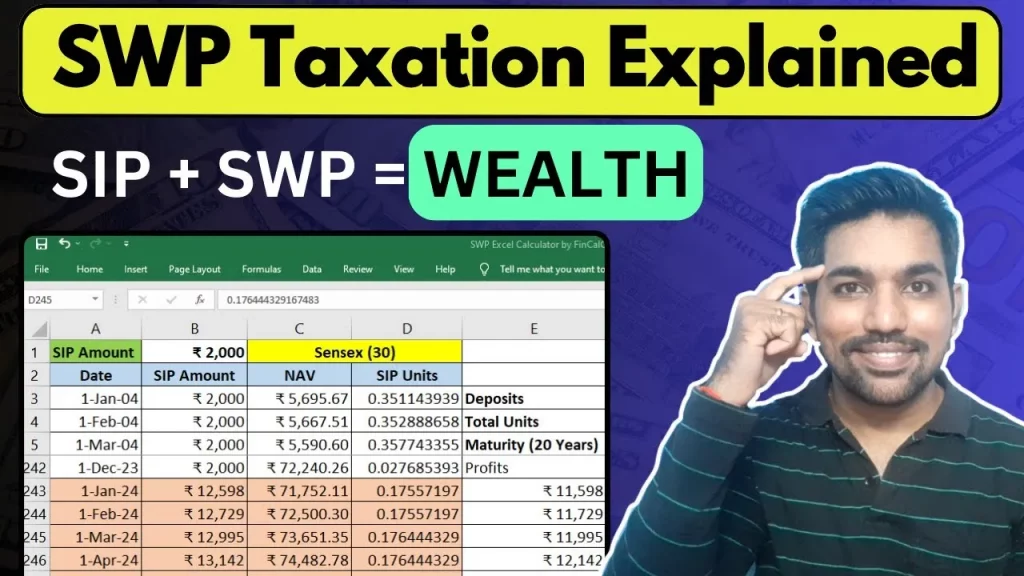
SWP or Systematic Withdrawal Plan is a way to get monthly income based on the amount you have saved in mutual funds. This amount helps you to cover the monthly expenses and also as a source of passive income. But it is also important to understand the SWP Taxation and how income tax will be calculated on SWP.
Download SWP Excel Calculator to know your monthly income using below button:
Let us understand SWP taxation with examples. Watch below video to see how income taxon SWP is calculated.
Income Tax on SWP for Monthly Income Video

Watch more Videos on YouTube Channel
What is SWP?
- SWP full form is Systematic Withdrawal Plan
- It helps you to get monthly income which will cover your expenses
- You invest via SIP (Systematic Investment Plan) and accumulate required funds to get retirement
- This accumulated funds can then be used to systematically withdraw from mutual funds to cover your monthly expenses
- SWP can be a good source of regular income, but returns from equity mutual funds are not guaranteed. Over 10+ years they have historically been around 10% to 12% a year, with some years negative
- When you withdraw money, you also have to pay tax, but only on the profit portion of each withdrawal, not on the full amount
- Based on how long you’ve held the units, that profit is taxed as STCG (Short Term Capital Gains) or LTCG (Long Term Capital Gains)
- For equity mutual funds in FY 2026-27, STCG is taxed at 20% and LTCG at 12.5% on gains above Rs. 1.25 lakh in a financial year
Let us now understand STCG and LTCG income tax on SWP.
How Income Tax is Calculated on SWP
Every SWP withdrawal is really you selling a few units of your mutual fund. So each month, your withdrawal has two parts: your original investment coming back (not taxed) and your profit (taxed). Tax applies only to the profit.
Here’s how the tax rates work for FY 2026-27 (AY 2027-28):
| Fund Type | Holding Period | Tax Rate |
|---|---|---|
| Equity funds (and hybrid funds with 65%+ equity) | Up to 12 months | 20% (STCG) |
| Equity funds (and hybrid funds with 65%+ equity) | More than 12 months | 12.5% on gains above Rs. 1.25 lakh a year (LTCG) |
| Debt funds bought after 1 April 2023 | Any period | Your income tax slab rate |
| Debt funds bought before 1 April 2023 | More than 24 months | 12.5%, no indexation |
The Rs. 1.25 lakh exemption is per financial year and covers all your long-term equity gains combined, including shares and other equity funds, not just your SWP.
SWP Tax Example: Rs. 50,000 Monthly Withdrawal
Let’s say Rahul invested Rs. 10 lakh in an equity fund 3 years ago at a NAV of Rs. 50, so he holds 20,000 units. The NAV is now Rs. 80, and he starts an SWP of Rs. 50,000 per month. To keep it simple, assume the NAV stays at Rs. 80 for the year.
- Units sold each month: Rs. 50,000 ÷ Rs. 80 = 625 units
- Original cost of those units: 625 × Rs. 50 = Rs. 31,250
- Profit in each withdrawal: Rs. 18,750 (the rest, Rs. 31,250, is his own money coming back)
Over 12 months:
- Total withdrawn: Rs. 6,00,000
- Total long-term gains: Rs. 18,750 × 12 = Rs. 2,25,000
- Less Rs. 1.25 lakh exemption = Rs. 1,00,000 taxable
- Tax at 12.5% = Rs. 12,500, plus 4% cess = Rs. 13,000
So Rahul pays about 2.2% tax on the Rs. 6 lakh he withdrew. If those same units had been held for less than 12 months, the Rs. 2.25 lakh gain would be taxed at 20%, which comes to roughly Rs. 46,800 including cess. That’s the difference holding period makes.
This is a simplified illustration. In reality, NAV changes every month, so the profit share of each withdrawal will vary.
How to Save Income Tax on SWP Withdrawal
There’s no way to avoid tax completely, but these steps can keep it low:
- Stay invested for 12+ months before starting SWP. This moves your gains from the 20% STCG rate to the 12.5% LTCG rate. Note that in an SWP, units are sold on a first-in, first-out basis, so the oldest units go first. You can’t pick which units are sold.
- Use your Rs. 1.25 lakh exemption every year. If your yearly long-term gains from SWP stay close to or below this amount, you may pay little or no tax.
- Prefer equity-oriented funds for long-term income. Equity gains get the lower LTCG rate, while debt fund gains are taxed at your slab rate, which can be as high as 30%.
- Spread investments across family members. If different family members hold investments in their own names from their own funds, each person gets their own Rs. 1.25 lakh exemption. Avoid simply moving money to a spouse for this purpose, since clubbing of income rules can apply.
- Keep your withdrawal rate sensible. A smaller withdrawal means smaller yearly gains realized, which keeps more of it under the exemption.
ALSO READ: Benefits of SWP in Mutual Funds
TDS and ITR Reporting on SWP
- No TDS for resident Indians. Mutual funds don’t deduct tax when you withdraw via SWP, so the tax is your responsibility. (NRIs are different, as TDS is deducted on their redemptions.)
- Report it in your ITR. Capital gains from SWP must be shown in your income tax return, usually in ITR-2 along with salary income. You can download your capital gains statement from your fund house or CAMS/KFintech.
- Pay advance tax if needed. If your total tax for the year is likely to be Rs. 10,000 or more, advance tax rules apply.
- Section 87A rebate won’t help here. The rebate can’t be used against tax on STCG or LTCG, even if your total income is within the rebate limit.
SWP vs SIP
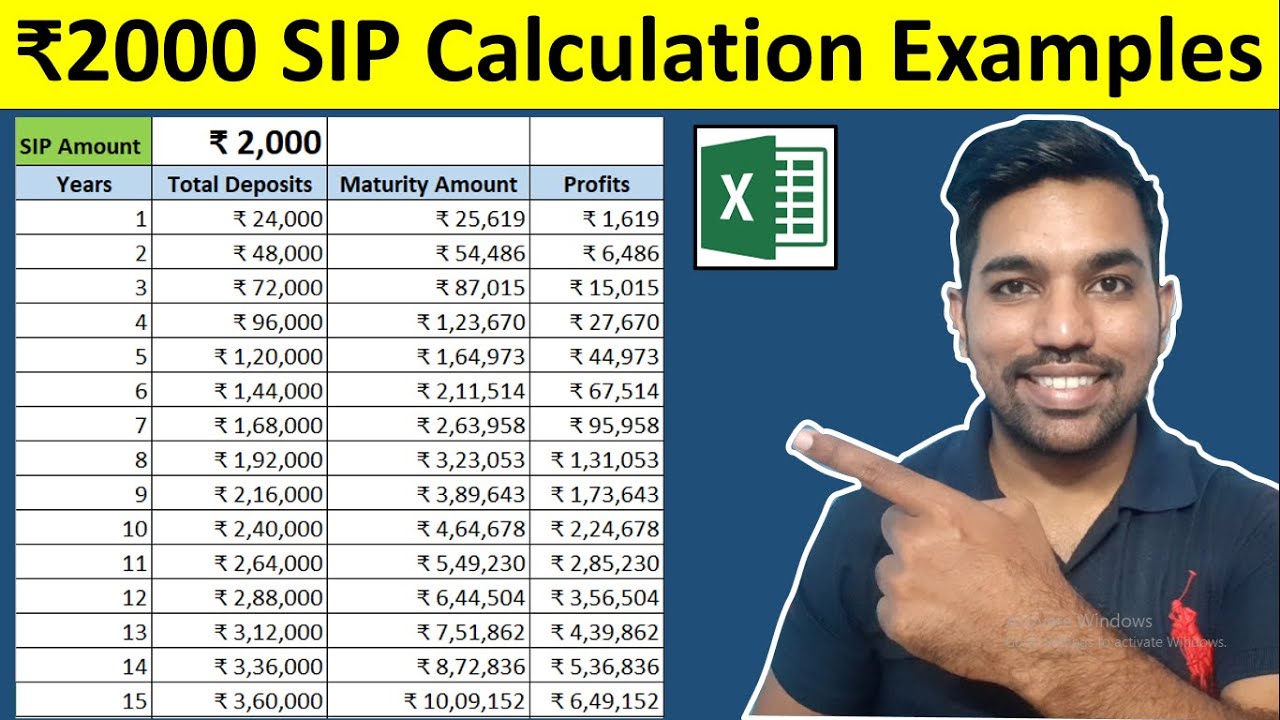
SIP and SWP work together: SIP builds your corpus while you’re earning, and SWP turns it into regular income later. For example, just a Rs. 2,000 monthly SIP can grow to lakhs of rupees in 10 to 15 years. Watch the video below to see how:
Rs. 2000 SIP Returns for 15 Years – Video
You can also download the SIP & lumpsum excel calculator using below button:
Conclusion
SWP is a flexible way to create monthly income from your mutual funds, and it’s often more tax-efficient than FD interest, because only the profit in each withdrawal is taxed. For equity funds, holding units for more than 12 months brings your tax down from 20% to 12.5%, with the first Rs. 1.25 lakh of yearly gains tax-free.
Before you start, run your numbers in our SWP Calculator, and read our guide on how SWP works for monthly income.
Frequently Asked Questions
Is the full SWP withdrawal amount taxable?
No. Each withdrawal has a part that’s your original investment (not taxed) and a part that’s profit (taxed). Only the profit portion is taxable.
Is SWP more tax-efficient than FD interest?
Often yes. FD interest is fully taxable at your slab rate every year. In an equity SWP, only the gains portion of each withdrawal is taxed, at 12.5% (after 12 months) with the first Rs. 1.25 lakh of yearly gains exempt. The trade-off is that equity funds carry market risk, while FDs don’t.
Which units are sold first in an SWP?
Units are sold on a first-in, first-out (FIFO) basis, meaning the oldest units are redeemed first. This works in your favour, since older units are more likely to qualify for the lower long-term rate.
How is SWP from a debt fund taxed?
For debt funds bought after 1 April 2023, gains are added to your income and taxed at your slab rate, whatever the holding period. There’s no Rs. 1.25 lakh exemption for debt funds.
Do I need to file ITR if my SWP gains are under Rs. 1.25 lakh?
You should still report the gains in your ITR. Even when long-term gains are within the exemption and no tax is due, they need to be disclosed. Your capital gains statement from the fund house will help you fill this in.
Has the SWP tax rate changed for FY 2026-27?
No. Budget 2026 made no changes to mutual fund capital gains rates or holding periods. The rates of 20% (STCG) and 12.5% (LTCG above Rs. 1.25 lakh) continue for FY 2026-27. The new Income-tax Act, 2025, which took effect on 1 April 2026, has renumbered sections but kept these rates the same.
Save Home Loan Interest Amount!
Use Home Loan Excel Calculator that will help you to Save Interest Amount on Home Loan EMI.
Click below button to download Home Loan EMI and Prepayment Calculator in Excel:
Watch how Home Loan Calculator in Excel Works
Income Tax Calculator App – FinCalC
For Income Tax Calculation on your mobile device, you can Download my Android App “FinCalC” which I have developed for you to make your income tax calculation easy.
What you can do with this mobile App?
- Calculate Income Tax for FY 2026-27 and previous FY 2025-26
- Enter estimated Investments to check income tax with Old and New Tax Regime
- Save income tax details and track regularly
- Know how much to invest more to save income tax
- More calculators including PPF, SIP returns, Savings account interest and lot more
Use Popular Calculators:
- Income Tax Calculator
- Home Loan EMI Calculator
- SIP Calculator
- PPF Calculator
- HRA Calculator
- Step up SIP Calculator
- Savings Account Interest Calculator
- Lump sum Calculator
- FD Calculator
- RD Calculator
- Car Loan EMI Calculator
- Bike Loan EMI Calculator
- Sukanya Samriddhi Calculator
- Provident Fund Calculator
- Senior Citizen Savings Calculator
- NSC Calculator
- Monthly Income Scheme Calculator
- Mahila Samman Savings Calculator
- Systematic Withdrawal Calculator
- CAGR Calculator
I’d love to hear from you if you have any queries about Personal Finance and Money Management.
JOIN Telegram Group and stay updated with latest Personal Finance News and Topics.
Download our Free Android App – FinCalC to Calculate Income Tax and Interest on various small Saving Schemes in India including PPF, NSC, SIP and lot more.
Follow the Blog and Subscribe to YouTube Channel to stay updated about Personal Finance and Money Management topics.
Disclaimer: Mutual Fund investments are subject to market risks, read all scheme related documents carefully. Registration granted by AMFI, membership of SIRO (if applicable), and certification from NISM in no way guarantee performance of the intermediary or provide any assurance of returns to investors.
Distributor Details: Name: Abhilash Gupta | AMFI Registered Mutual Fund Distributor | ARN: 367014