April 1, 2026 was not just the start of a new financial year. RBI used this date to roll out some of the most consumer-friendly banking changes in recent years. Some of these changes directly put money back in your pocket — like zero prepayment penalties on loans. Others protect your family — like the new nomination rules. And some change how you interact with your bank every single day — like the new ATM and digital payment rules.
If you have a savings account, a home loan, an FD, or simply use UPI to pay your bills, at least 3 to 4 of these changes affect you directly. Let me walk you through each one, clearly and with examples.
- New Banking Rules 2026 Video
- 1. BSBD Accounts Get a Major Upgrade – Zero Balance, Zero Charges
- 2. ATM Withdrawal Rules and Charges – What Changes
- 3. No Prepayment Penalty on Floating Rate Loans
- 4. CIBIL Score Updated More Frequently
- 5. Up to 4 Nominees Now Allowed – Protect Your Family
- 6. Mandatory Two-Factor Authentication for All Digital Payments
- 7. New Rules for High-Value Cash Deposits – PAN Now Mandatory
- 8. Stricter Rules for Dormant and Inactive Accounts
- 9. New LCR Rules – How Banks Hold Your Digital Money
- Summary of All New Banking Rules from April 2026
- Frequently Asked Questions on New Banking Rules 2026
- Does the no prepayment penalty rule apply to fixed rate loans?
- Can I still use only 1 nominee if I want?
- Will my savings account interest rate fall because of the new LCR rules?
- What happens if my account goes dormant — do I lose my money?
- Does 2FA apply to small UPI transactions like Rs. 10 or Rs. 50?
- Conclusion
New Banking Rules 2026 Video

Watch more Videos on YouTube Channel
1. BSBD Accounts Get a Major Upgrade – Zero Balance, Zero Charges
This is the biggest and most detailed change RBI has made, and it benefits crores of Indians who use basic savings accounts.
BSBD stands for Basic Savings Bank Deposit Account — the zero-balance account that is available at every bank. RBI has completely revised the rules for these accounts, effective April 1, 2026.
What you now get for FREE in a BSBD account:
- No minimum balance requirement — no penalty ever
- ATM cum Debit Card with zero annual charges, at issuance and renewal
- Cheque book with minimum 25 free cheque leaves per year
- Free passbook, or monthly e-statement by email if you prefer
- Free internet banking and mobile banking
- Minimum 4 free withdrawals per month — across ATM, branch or transfer
In a significant push towards digital banking, RBI has ruled that UPI, NEFT, RTGS and IMPS transactions will not be counted as withdrawals under BSBD rules. This means your 4 free withdrawals per month are not eaten up by your online payments.
What banks cannot do anymore:
- Banks cannot force you to use a cheque book, ATM card or digital banking. All these are optional — you choose what you need
- Banks cannot levy annual fees at the time of issuance or renewal of ATM or debit cards for BSBD accounts
- Banks must convert your existing savings account to a BSBD account within 7 working days if you request it
Who should pay attention to this? If you or any family member — parents, domestic workers, anyone — has a savings account where they are paying annual debit card fees or getting penalized for low balance, request a conversion to BSBD account. It is your right under the new rules.
2. ATM Withdrawal Rules and Charges – What Changes
UPI withdrawals will now be counted together with debit card withdrawals for the free transaction limit. You can withdraw freely 3 times per month in metro cities and 5 times in non-metro cities. After that, each withdrawal will attract Rs. 23 plus GST as charges.
This is an important change to understand clearly:
| Location | Free Withdrawals per Month | Charge After Free Limit |
|---|---|---|
| Metro cities | 3 transactions | Rs. 23 + GST per transaction |
| Non-metro cities | 5 transactions | Rs. 23 + GST per transaction |
- Earlier, UPI transactions were not counted in ATM withdrawal limits. Now they are counted together
- This is RBI’s push to get people to think before making unnecessary cash withdrawals
- For most salaried people who use UPI regularly, this may not make a big difference — but it is good to track your monthly withdrawal count
ALSO READ: Credit Card vs Debit Card Difference
3. No Prepayment Penalty on Floating Rate Loans
This is one of the most borrower-friendly changes in recent years — and one that directly affects anyone with a home loan, personal loan or car loan.
Banks cannot charge a foreclosure or pre-payment penalty on individuals for closing their loans early. Loans covered under this rule include home loans on floating rate, individual loans on floating rate, and some MSME loans taken by individuals.
What this means in practice:
Say you have a home loan of Rs. 40 Lakh outstanding. You receive a bonus of Rs. 5 Lakh and want to make a partial prepayment. Earlier, many banks charged 2% to 5% of the prepayment amount as a penalty — which on Rs. 5 Lakh works out to Rs. 10,000 to Rs. 25,000 in charges. Under the new rules, that charge is Rs. 0.
- This applies to floating rate loans — the interest rate that changes with RBI repo rate
- Fixed rate loans may still have prepayment charges — check your loan agreement
- This rule applies to loans sanctioned or renewed after January 1, 2026
- If you have a windfall — bonus, inheritance, matured investment — this is your signal to consider prepaying your home or personal loan
I have already explained in the home loan article that reducing tenure during prepayment saves more interest than reducing EMI. This rule now makes that decision even easier since there is no penalty to worry about. Watch below video to know the calculations on prepayment
Home Loan Prepayment Examples Video

Watch more Videos on YouTube Channel
Download Home Loan Excel Calculator using below button:
4. CIBIL Score Updated More Frequently
Your CIBIL score is what determines whether you get a loan, at what interest rate, and with what terms. Until recently, this score updated roughly once every 30 days — which meant if you cleared a loan or paid off a credit card, you sometimes had to wait a full month before your score reflected it.
Your CIBIL score will now be refreshed every 7 days — for example – on the 7th, 14th, 21st, and 28th of each month. Previously, borrowers had to wait for weeks before their repayments would reflect on their credit scores.
Why this matters for you:
- If you are planning to apply for a home loan or personal loan in the next few months, clearing outstanding dues will now reflect faster in your score
- On the flip side — if you miss an EMI payment or delay a credit card payment, that will also reflect faster
- Payment discipline is now non-negotiable if you want to maintain a good score
⚠ Note: Some viral messages are claiming CIBIL score will update on exactly fixed weekly dates for everyone. The actual RBI directive is toward faster and more frequent reporting by lenders. The movement is in the right direction — but the exact weekly schedule may vary depending on how quickly individual banks update their data to CIBIL.
5. Up to 4 Nominees Now Allowed – Protect Your Family
Earlier, you could add only 1 nominee to your savings account, FD or bank locker. This single nominee rule caused problems in cases where the nominee had passed away before the account holder, or where families wanted to distribute the money among multiple members.
You can now name up to 4 nominees for your savings account, Fixed Deposits or lockers. You can also specify the percentage share for each nominee — so if you have 2 children and want to split your FD 50-50 between them, you can do that now.
Why you should act on this immediately:
- Log in to your bank’s mobile app or visit your branch and update your nominations today
- This is especially important for FDs, lockers, and accounts you opened years ago that may still have outdated nominee details
- Having clear nominations prevents legal disputes and ensures your family can access funds without going through a lengthy court process
6. Mandatory Two-Factor Authentication for All Digital Payments
From April 1, 2026, the Reserve Bank of India has rolled out mandatory two-factor authentication for all digital transactions, marking a significant shift in how payments are secured across the country. The rules apply across all major payment systems including UPI, NEFT, RTGS and card transactions.
In simple words — a single OTP is no longer always sufficient. RBI has introduced a principle-based framework where banks can require biometric verification, a pre-set secure PIN, or a second authentication step — especially for high-value or unusual transactions.
- For routine small UPI payments, you may not notice any change
- For high-value transactions or transactions from a new device or location, expect an additional authentication step
- Banks are also promoting risk-based authentication, where stricter checks apply for high-risk transactions such as unusual spending patterns or unfamiliar locations
What you should do: Keep your registered mobile number and email updated with your bank. Enable biometric login on your banking app if available. Never share OTPs or PINs with anyone — even people claiming to be from the bank.
ALSO READ: Latest Post Office Interest Rates
7. New Rules for High-Value Cash Deposits – PAN Now Mandatory
If you deposit cash worth Rs. 10,00,000 or more, the bank is now responsible for informing the Income Tax Department. Cash FD deposits above Rs. 10,00,000 will also be flagged. The new rules may also require PAN for making a withdrawal or deposit of more than Rs. 10 Lakh.
This is not a new concept — large cash transactions have always been reported. But the threshold monitoring has been tightened and the process made more systematic from April 2026.
- This affects people who deal with large cash — business owners, traders, those receiving large cash gifts
- For salaried individuals, this is unlikely to affect your day-to-day banking
- If you are making a large fixed deposit in cash, keep your PAN card ready and be prepared for the bank to report it to the IT department
8. Stricter Rules for Dormant and Inactive Accounts
RBI will close dormant accounts — those with no activity for 2 years — and inactive accounts where there has been no customer-initiated transaction for 12 months. Zero-balance accounts with outdated KYC will also be closed.
This is something many people overlook. If you have old salary accounts from previous employers, or accounts opened years ago that you no longer use — check them.
What to do:
- Log in to any account you have not used in a while and make at least one transaction
- Update your KYC if it has not been done recently — your Aadhaar, PAN and mobile number should be linked and verified
- If you have multiple accounts you do not need, consolidate — it simplifies your financial life and reduces the risk of one account going dormant without you noticing
9. New LCR Rules – How Banks Hold Your Digital Money
This one is more technical but worth understanding as it may affect FD and savings account interest rates going forward.
As per the new Liquidity Coverage Ratio guidelines, banks are required to assign an additional run-off rate of 2.5 per cent to deposits made through internet and mobile banking channels by retail and small business customers. Banks must also apply haircuts to the market value of Government Securities classified as Level 1 High-Quality Liquid Assets.
In simple words — for every Rs. 100 you keep in a digitally-linked savings account, the bank now has to set aside more cash as a safety buffer. This is RBI’s protection against digital bank runs — a situation where a social media rumour causes thousands of people to simultaneously withdraw money via apps.
To counter the higher cost of maintaining digital savings buffers, banks are expected to pivot toward Fixed Deposits. Since FDs have a lock-in period, they are not subject to the same high-velocity digital buffer requirements.
What this means for you practically:
- Expect banks to offer attractive FD rates to encourage you to move money from savings accounts to FDs
- Your savings account interest rate may not go up — but FD rates may improve
- If you have a large amount sitting idle in your savings account, this is a good time to consider moving a portion into short-term FDs
Summary of All New Banking Rules from April 2026
| Rule | What Changed | Who is Affected |
|---|---|---|
| BSBD Account | Free debit card, cheque book, net banking, 4 free withdrawals | All zero-balance account holders |
| ATM Charges | UPI + ATM withdrawals counted together, Rs. 23 + GST after free limit | All savings account holders |
| No Prepayment Penalty | Zero charges to close floating rate loans early | Home loan, personal loan borrowers |
| CIBIL Score Update | More frequent updates — every 7 days | All loan and credit card holders |
| Nominations | Up to 4 nominees allowed with percentage split | All account and FD holders |
| 2FA for Digital Payments | Mandatory second factor authentication | All UPI and digital payment users |
| High Cash Deposits | PAN mandatory above Rs. 10 Lakh, IT dept notified | Business owners, large cash depositors |
| Dormant Accounts | Accounts inactive for 2 years may be closed | Anyone with old, unused accounts |
| LCR Norms | Banks hold more buffer for digital deposits | May affect FD and savings interest rates |
Frequently Asked Questions on New Banking Rules 2026
Does the no prepayment penalty rule apply to fixed rate loans?
No. This rule applies specifically to floating rate loans for individual borrowers. Fixed rate loan prepayment penalties may still apply — check your loan agreement.
Can I still use only 1 nominee if I want?
Yes. The new rule allows up to 4 nominees but does not make it mandatory. If you are comfortable with 1 nominee, you can keep it as is.
Will my savings account interest rate fall because of the new LCR rules?
Not necessarily. But the incentive for banks to offer higher FD rates increases. Keep an eye on FD offers from your bank in the coming months.
What happens if my account goes dormant — do I lose my money?
No. Your money is safe. But the account gets frozen for transactions. To reactivate it, you need to visit your branch with KYC documents and make a transaction.
Does 2FA apply to small UPI transactions like Rs. 10 or Rs. 50?
For very small routine transactions on known payees, banks may not trigger additional authentication. The enhanced 2FA is primarily aimed at high-value transactions and transactions from new or unusual locations.
Conclusion
The April 2026 banking changes are overall positive for customers — lower penalties, better protection, more transparency, and stronger digital security. The most important actions to take right now are to update your nominations, check your dormant accounts, and if you have a floating rate home loan with a large outstanding, consider making a partial prepayment with zero penalty. Use the calculators on fincalc blog to calculate exactly how much interest you can save with prepayment before making that decision.
Some more Reading:
Save Home Loan Interest Amount!
Use Home Loan Excel Calculator that will help you to Save Interest Amount on Home Loan EMI.
Click below button to download Home Loan EMI and Prepayment Calculator in Excel:
Watch how Home Loan Calculator in Excel Works
Income Tax Calculator App – FinCalC
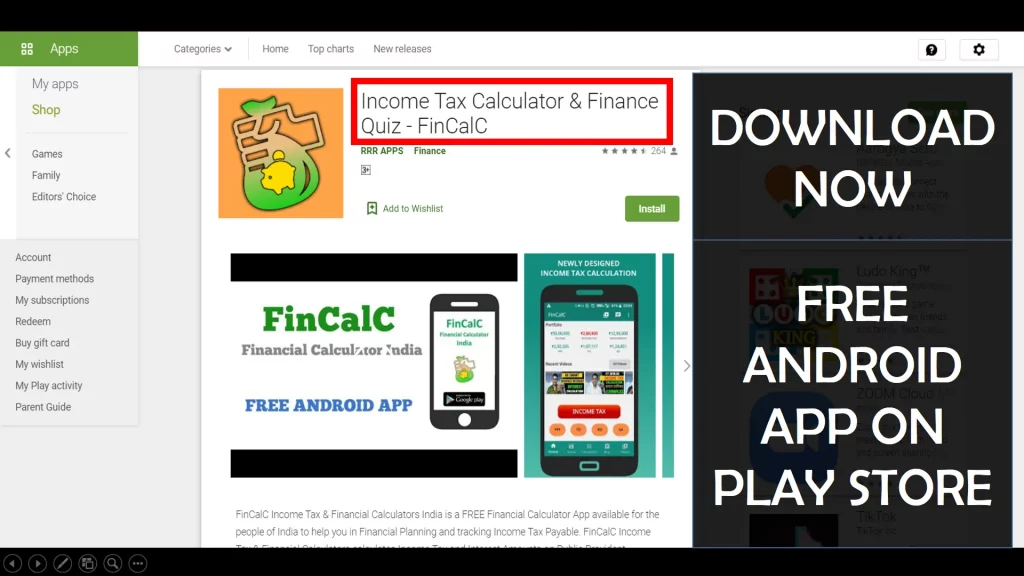
For Income Tax Calculation on your mobile device, you can Download my Android App “FinCalC” which I have developed for you to make your income tax calculation easy.
What you can do with this mobile App?
- Calculate Income Tax for FY 2025-26 and previous FY 2024-25
- Enter estimated Investments to check income tax with Old and New Tax Regime
- Save income tax details and track regularly
- Know how much to invest more to save income tax
- More calculators including PPF, SIP returns, Savings account interest and lot more
Use Popular Calculators:
- Income Tax Calculator
- Home Loan EMI Calculator
- SIP Calculator
- PPF Calculator
- HRA Calculator
- Step up SIP Calculator
- Savings Account Interest Calculator
- Lump sum Calculator
- FD Calculator
- RD Calculator
- Car Loan EMI Calculator
- Bike Loan EMI Calculator
- Sukanya Samriddhi Calculator
- Provident Fund Calculator
- Senior Citizen Savings Calculator
- NSC Calculator
- Monthly Income Scheme Calculator
- Mahila Samman Savings Calculator
- Systematic Withdrawal Calculator
- CAGR Calculator
I’d love to hear from you if you have any queries about Personal Finance and Money Management.
JOIN Telegram Group and stay updated with latest Personal Finance News and Topics.
Download our Free Android App – FinCalC to Calculate Income Tax and Interest on various small Saving Schemes in India including PPF, NSC, SIP and lot more.
Follow the Blog and Subscribe to YouTube Channel to stay updated about Personal Finance and Money Management topics.
Disclaimer: Mutual Fund investments are subject to market risks, read all scheme related documents carefully. Registration granted by AMFI, membership of SIRO (if applicable), and certification from NISM in no way guarantee performance of the intermediary or provide any assurance of returns to investors.
Distributor Details: Name: Abhilash Gupta | AMFI Registered Mutual Fund Distributor | ARN: 367014