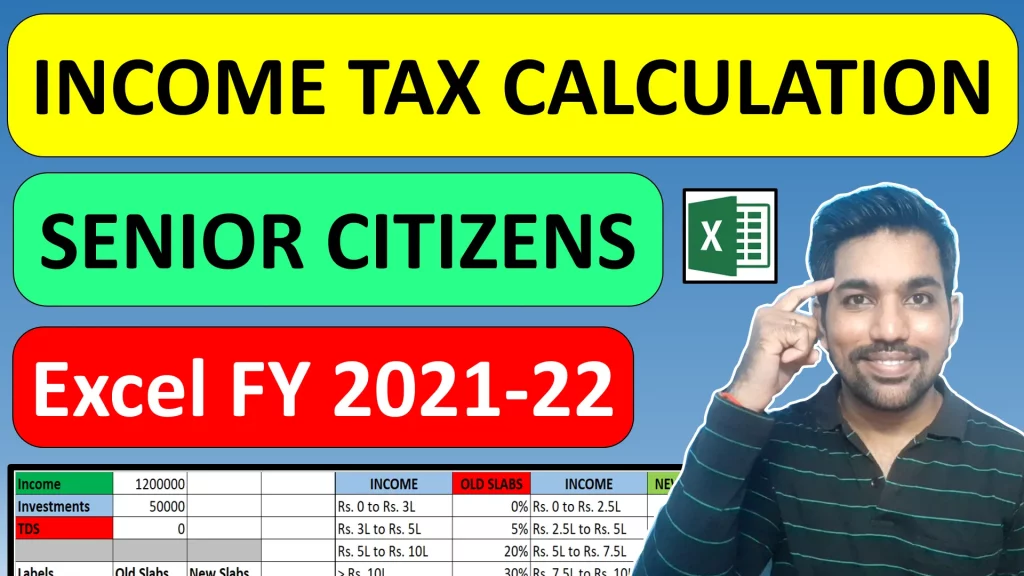
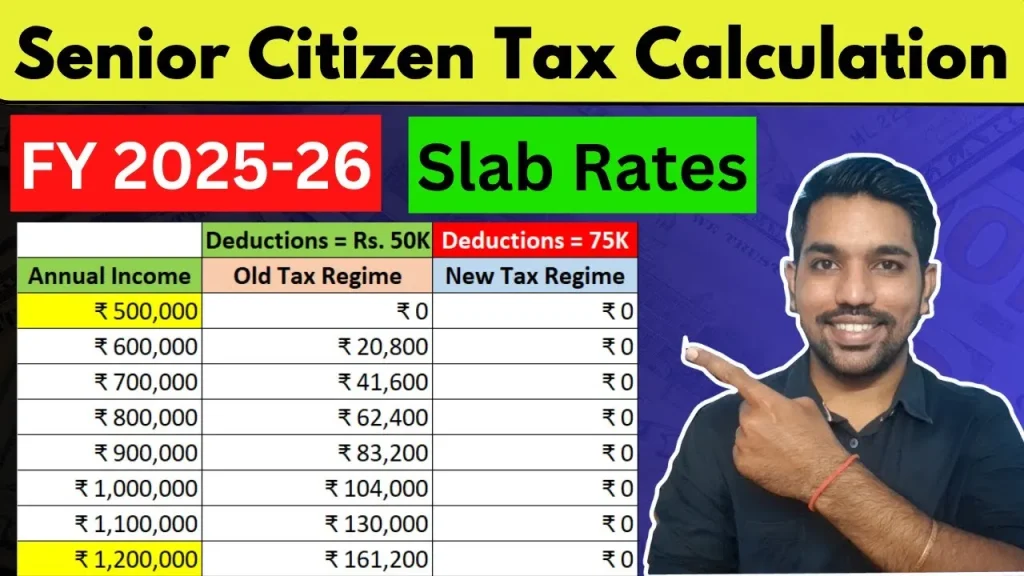
Did you know that a senior citizen earning ₹12 lakh under the New Tax Regime pays zero tax due to Section 87A rebate and marginal relief? Yet, the same income under the Old Regime could attract over ₹1.5 lakh in tax. A Senior Citizen Income Tax Calculator shows these differences instantly, helping you choose the smarter regime and maximize savings. With just a few inputs, you can see how much tax you really owe—and how much you can save.
Use below Income Tax Calculator for Senior Citizen along with Excel Calculator:
Senior Citizen Income Tax Calculator Video
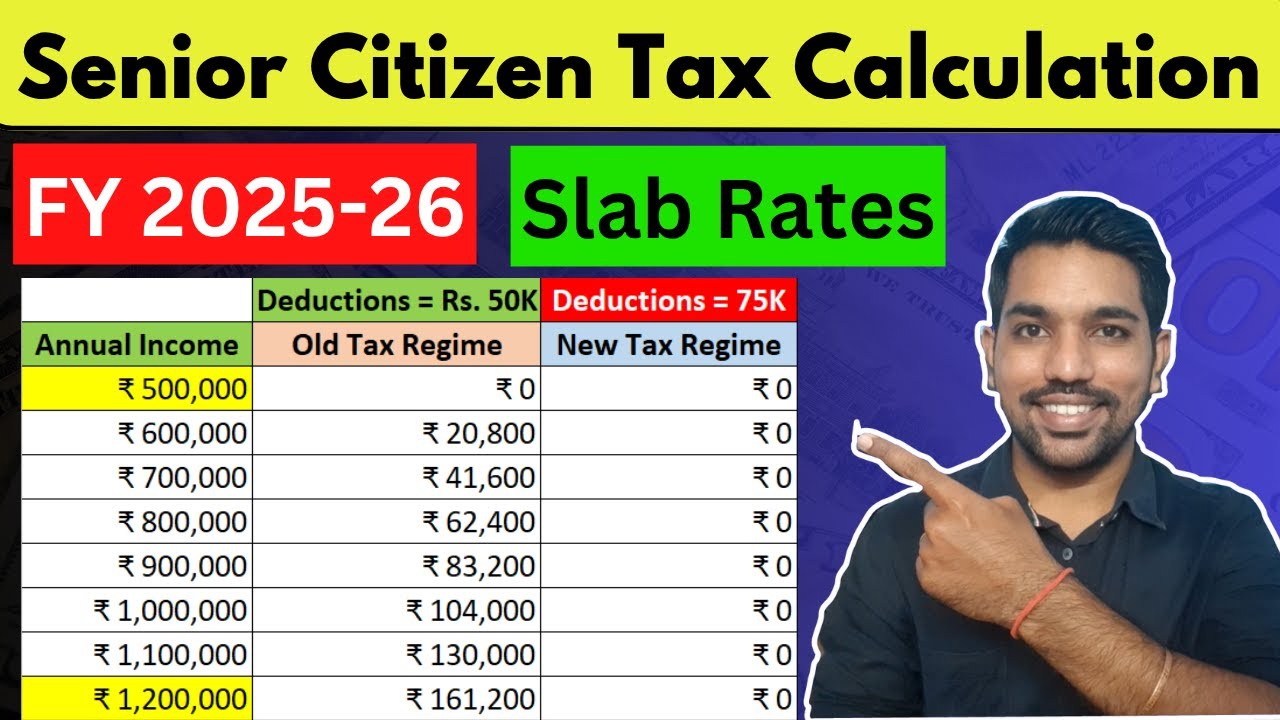
Watch more Videos on YouTube Channel
Income Tax Slab Rates for Senior Citizens
Senior Citizens have the option to choose between Old tax regime and new tax regime for FY 2025-26 and FY 2026-27.
Below is the tax slab rates based on Old Tax Regime:
Old Tax Regime Slab Rates (FY 2025–26 and FY 2026-27)
For Senior Citizens (60–80 years):
- Up to ₹3,00,000 → No tax
- ₹3,00,001 – ₹5,00,000 → 5%
- ₹5,00,001 – ₹10,00,000 → 20%
- Above ₹10,00,000 → 30%
For Super Senior Citizens (80+ years):
- Up to ₹5,00,000 → No tax
- ₹5,00,001 – ₹10,00,000 → 20%
- Above ₹10,00,000 → 30%
Below is the Tax Slab rates for new tax regime for all age groups:
New Tax Regime Slab Rates (FY 2025–26 and FY 2026-27)
Under the New Regime, there is no higher exemption for senior citizens. The slabs are same for all individuals:
- Up to ₹4,00,000 → No tax
- ₹4,00,001 – ₹8,00,000 → 5%
- ₹8,00,001 – ₹12,00,000 → 10%
- ₹12,00,001 – ₹16,00,000 → 15%
- ₹16,00,001 – ₹20,00,000 → 20%
- ₹20,00,001 – ₹24,00,000 → 25%
- Above ₹24,00,000 → 30%
Here are few key points to remember:
- Old Regime benefits senior citizens with higher exemption limits
- New Regime is simpler and has lower slab rates but does not differentiate by age
- Senior citizens should compare both regimes to see which regime offers greater tax savings based on their income and deductions / investments
- Rebate under Section 87A is available in both regimes, making income up to ₹12 lakh effectively tax-free under the New Regime
How to calculate income tax of senior citizens?
Below is a step‑by‑step guide on how to calculate income tax for senior citizens:
- Identify Age Category
- Senior Citizen: 60–80 years
- Super Senior Citizen: 80+ years
- Choose Tax Regime
- Old Regime: Higher exemption limits (₹3 lakh for seniors, ₹5 lakh for super seniors).
- New Regime: Uniform slabs for all, but simpler structure.
- Calculate Gross Income
- Add salary, pension, rental income, interest, and other sources.
- Example: Pension ₹6,00,000 + FD interest ₹1,00,000 = ₹7,00,000 (total income)
- Deduct Allowable Exemptions
- Standard deduction (₹50,000 for pension/salary).
- Example: ₹7,00,000 – ₹50,000 = ₹6,50,000
- Deducting investments or deductions from total income goves you Taxable Income – on which income tax is calculated
- Apply Deductions under Sections (Old Regime)
- Section 80C (up to ₹1.5 lakh for investments like PPF, LIC).
- Section 80D (health insurance premium, higher limits for seniors).
- Example: ₹6,50,000 – ₹1,50,000 (80C) – ₹50,000 (80D) = ₹4,50,000 taxable income.
- Check Basic Exemption Limit
- Senior Citizens: ₹3,00,000
- Super Senior Citizens: ₹5,00,000
- Apply Slab Rates
- For senior citizens (Old Regime):
- ₹3,00,001–₹5,00,000 → 5%
- ₹5,00,001–₹10,00,000 → 20%
- Above ₹10,00,000 → 30%
- For senior citizens (Old Regime):
- Calculate Tax Liability
- Example: Taxable income ₹4,50,000 → 5% of ₹1,50,000 = ₹7,500.
- Apply Rebate under Section 87A
- If taxable income ≤ ₹5,00,000 (Old Regime) or ≤ ₹12,00,000 (New Regime), tax liability becomes zero.
- Add Health & Education Cess
- 4% of tax payable.
- Example: ₹7,500 + 4% cess = ₹7,800.
- Final Tax Payable
- After rebate, if applicable, the final tax may be nil.
- Example: For ₹4,50,000 taxable income, rebate cancels tax → ₹0 payable.
- Compare Old vs. New Regime
- Senior citizens should calculate under both regimes and choose whichever gives lower tax liability.
- You can make use of above income tax calculator to quickly check your income tax based on old and new tax regimes
Example:
A 65‑year‑old with ₹7 lakh income, after deductions, has ₹4.5 lakh taxable income. Under the Old Regime, tax is ₹7,500, but rebate under Section 87A makes it zero. Under the New Regime, if taxable income ≤ ₹12 lakh, rebate also makes tax zero.
In old tax regime, you get maximum tax rebate of ₹12,500, where as in new tax regime, the tax rebate limit is ₹60,000.
What is the limit of senior citizen tax in FY 25-26?
For FY 2025–26 (AY 2026–27), senior citizens enjoy higher exemption limits under the Old Tax Regime compared to regular taxpayers. For individuals aged 60–80 years, the basic exemption limit is ₹3,00,000, while for super senior citizens (80+ years) it is ₹5,00,000.
Under the New Tax Regime, however, the exemption limit is uniform at ₹4,00,000 for all taxpayers, regardless of age. This means senior citizens benefit more under the Old Regime, especially if they have deductions to claim, while the New Regime offers simplicity but no age-based concessions.
ALSO READ: Deductions under New Tax Regime to Save Income Tax
Is 12 lakh income tax free for senior citizens?
Under the New Tax Regime for FY 2025–26 and FY 2026-27, a senior citizen earning ₹12 lakh annually can effectively pay zero tax due to the revised slab structure and rebate available under Section 87A. The regime provides lower tax rates across slabs and a rebate under Section 87A that ensures no tax liability if taxable income is up to ₹12 lakh.
For example, suppose a 65‑year‑old has a total income of ₹12 lakh. After applying the new regime slabs, the calculated tax would normally be payable – Rs. 60,000. However, the rebate under Section 87A (Maximum Rs. 60,000) completely offsets this liability, making the final tax nil. This benefit applies uniformly to all taxpayers, including senior citizens, under the new regime.
Thus, under the New Tax Regime, a senior citizen with ₹12 lakh income does not pay any income tax, making it a highly attractive option compared to the Old Regime.
Note that Section 87A tax rebate is not available when taxable income is above Rs. 12 Lakh in the financial year.
Tax Rebate 87A for Senior Citizens
Below are the key points about Tax Rebate under Section 87A for Senior Citizens:
- Eligibility: Available to all resident individuals, including senior citizens, provided their taxable income does not exceed the specified threshold
- Threshold Limit (New Regime): For FY 2025–26, if taxable income is up to ₹12 lakh, the rebate under Section 87A makes the tax liability zero
- Threshold Limit (Old Regime): Under the Old Regime, the rebate applies if taxable income is up to ₹5 lakh.
- Maximum Rebate Limit (New Regime): For FY 2025–26, if taxable income is up to ₹12 lakh, the maximum rebate under Section 87A is Rs. 60,000
- Maximum Rebate Limit (Old Regime): Under the Old Regime, the maximum rebate is Rs. 12,500, if taxable income is up to ₹5 lakh.
- Rebate Amount: The rebate equals the total tax payable before cess, subject to the maximum limit prescribed (effectively reducing tax to nil within the threshold).
- Example (New Regime): A 65‑year‑old with taxable income of ₹11.8 lakh will have tax calculated as per slabs, but Section 87A rebate cancels it entirely → Final tax = ₹0.
- Example (Old Regime): A 70‑year‑old with taxable income of ₹4.8 lakh will owe ~₹9,000 tax, but rebate under 87A wipes it out → Final tax = ₹0.
- Uniform Benefit: The rebate applies equally to senior citizens and other resident individuals – age does not affect eligibility.
- Choice of Regime Matters: Senior citizens should compare Old vs. New Regime, as the rebate threshold is much higher in the New Regime compared to old tax regime
In short: Section 87A is a powerful relief tool—under the New Regime, it makes income up to ₹12 lakh completely tax‑free for senior citizens, while under the Old Regime, the limit is ₹5 lakh.
What is Marginal Relief in New Tax Regime
Marginal Relief helps you to save tax when taxable income is above Rs. 12 lakh and you are not eligible for tax rebate Section 87A
- Purpose: Marginal relief is designed to prevent a sudden jump in tax liability when income crosses the exemption limit under the new regime
- Threshold: Under Budget 2025, income up to ₹12 lakh (₹12.75 lakh for salaried individuals with standard deduction) is tax‑free
- Mechanism: If income slightly exceeds ₹12 lakh, the tax payable is capped (limited) so that it does not exceed the incremental income above ₹12 lakh.
- Example 1:
- Taxpayer earns ₹12,10,000.
- Without marginal relief, tax could be more than Rs. 60,000 as per slab rates and no tax rebate eligibility.
- With marginal relief, the extra tax payable is limited to ₹10,000 (the amount exceeding ₹12 lakh).
- Example 2:
- A salaried senior citizen earns ₹12,70,000 (including standard deduction).
- Tax is calculated as per slabs, but marginal relief ensures the tax payable is not more than ₹70,000, the excess over ₹12 lakh.
- Benefit: This marginal relief provision protects taxpayers from sudden tax shocks and ensures fairness in the transition from tax‑free to taxable income. Due to this, if person 1 has income = Rs. 12 lakh – tax will be zero, but if person 2 has income = Rs. 12,10,000, only the additional Rs. 10,000 + cess 4% needs to be paid as tax rather than paying Rs. 60,000+ as tax due to non eligibility of Section 87A rebate
ALSO READ: Marginal Relief Exaplined with examples
Which Tax Regime is Better for Senior Citizens?
For senior citizens, the better tax regime depends on income level and deductions available. The Old Regime is more beneficial if they have significant deductions (like 80C, 80D, or housing loan interest) because of higher exemption limits.
The New Regime, however, is simpler and offers a big advantage—income up to ₹12 lakh is effectively tax‑free due to Section 87A rebate and marginal relief. In practice, seniors with fewer deductions often benefit more from the New Regime, when income is within Rs. 12 Lakh in financial year
Conclusion
A Senior Citizen Income Tax Calculator is a powerful tool that simplifies complex tax rules and helps individuals (senior citizens) quickly estimate their liability under both regimes. By factoring in age‑based exemptions, deductions, and rebates like Section 87A, it ensures senior citizens can make informed decisions about which regime saves them more.
With clear step‑by‑step calculations, it reduces confusion and empowers seniors to plan their finances better. Ultimately, it transforms tax filing from a stressful task into a manageable, transparent process. You can also download the income tax calculator in excel from top of this article to check the tax calculations with old and new tax regimes
Some more Reading:
Save Home Loan Interest Amount!
Use Home Loan Excel Calculator that will help you to Save Interest Amount on Home Loan EMI.
Click below button to download Home Loan EMI and Prepayment Calculator in Excel:
Watch how Home Loan Calculator in Excel Works
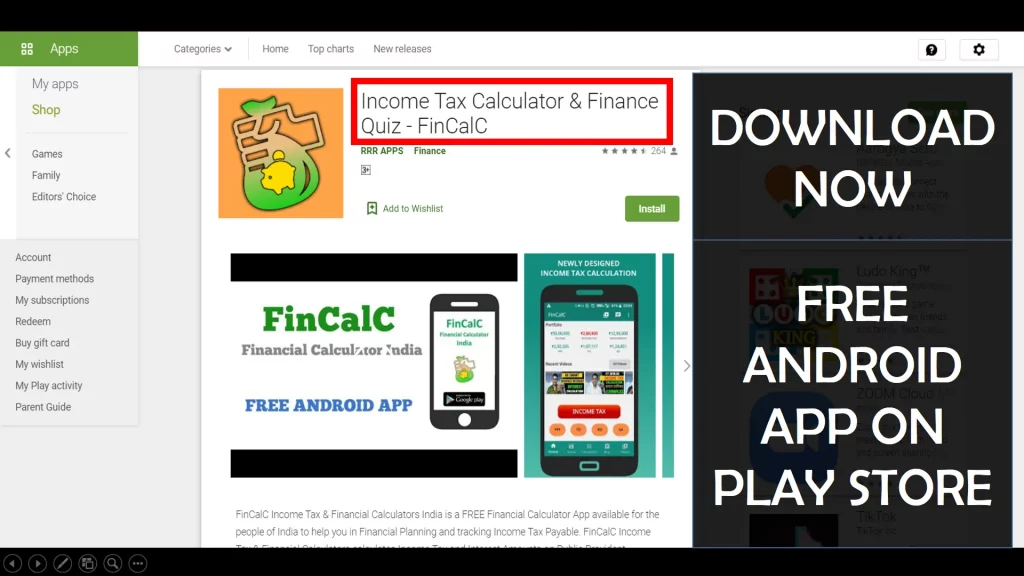
Income Tax Calculator App – FinCalC
For Income Tax Calculation on your mobile device, you can Download my Android App “FinCalC” which I have developed for you to make your income tax calculation easy.
What you can do with this mobile App?
- Calculate Income Tax for FY 2025-26 and previous FY 2024-25
- Enter estimated Investments to check income tax with Old and New Tax Regime
- Save income tax details and track regularly
- Know how much to invest more to save income tax
- More calculators including PPF, SIP returns, Savings account interest and lot more
Use Popular Calculators:
- Income Tax Calculator
- Home Loan EMI Calculator
- SIP Calculator
- PPF Calculator
- HRA Calculator
- Step up SIP Calculator
- Savings Account Interest Calculator
- Lump sum Calculator
- FD Calculator
- RD Calculator
- Car Loan EMI Calculator
- Bike Loan EMI Calculator
- Sukanya Samriddhi Calculator
- Provident Fund Calculator
- Senior Citizen Savings Calculator
- NSC Calculator
- Monthly Income Scheme Calculator
- Mahila Samman Savings Calculator
- Systematic Withdrawal Calculator
- CAGR Calculator
I’d love to hear from you if you have any queries about Personal Finance and Money Management.
JOIN Telegram Group and stay updated with latest Personal Finance News and Topics.
Download our Free Android App – FinCalC to Calculate Income Tax and Interest on various small Saving Schemes in India including PPF, NSC, SIP and lot more.
Follow the Blog and Subscribe to YouTube Channel to stay updated about Personal Finance and Money Management topics.